 Clinic
Short Communication | DOI: https://doi.org/10.31579/2835-7957/165
Venous Resection Associated with Pancreaticoduodenectomy: Indications, Techniques, and Prognostic Impact
- Menoura Raouf 1*
- Tibermacine Walid 2
- Rais Bouchera 1
- Bouzitouna Reda 1
- Ammari Abd Alaziz 3
- Bouceneche Lhacen 1
- Aoun Allah Imene 1
- Delmi Abd Elhak 3
¹Department of Surgery B, CHU Constantine, Algeria.
²Department of Radiology, CHU Constantine, Algeria.
³Department of Oncology, EH Didouche Mourad, Constantine, Algeria. Mentouri University 3, Constantine, Algeria.
*Corresponding Author: Menoura Raouf., Department of Surgery B, CHU Constantine, Algeria.
Citation: Menoura Raouf, Tibermacine Walid, Rais Bouchera, Bouzitouna Reda, Ammari A. Alaziz, et al, (2026), Venous Resection Associated with Pancreaticoduodenectomy: Indications, Techniques, and Prognostic Impact, Clinical Reviews and Case Reports, 5(3); DOI:10.31579/2835-7957/165
Copyright: © 2026, Menoura Raouf. This is an open-access article distributed under the terms of the Creative Commons Attribution License, which permits unrestricted use, distribution, and reproduction in any medium, provided the original author and source are credited.
Received: 01 May 2026 | Accepted: 14 May 2026 | Published: 20 May 2026
Keywords: pancreatic cancer; venous resection; portal vein; superior mesenteric vein; pancreaticoduodenectomy; borderline tumors
Abstract
Involvement of the portal vein (PV) or superior mesenteric vein (SMV) is a frequent finding in pancreatic head adenocarcinoma, observed in approximately 30–40% of cases at diagnosis. Historically considered a contraindication to surgical resection, venous invasion is now integrated into the resectability criteria for borderline tumors. The association of venous resection with pancreaticoduodenectomy currently provides satisfactory oncological outcomes, provided that patients are carefully selected and appropriate surgical expertise is ensured. This study aims to provide a comprehensive analysis of the indications, reconstruction techniques, and prognostic impact of this strategy.
Introduction
Pancreatic adenocarcinoma remains a disease with poor prognosis, characterized by early locoregional spread and close anatomical relationships with major vascular structures. Involvement of the portal vein and superior mesenteric vein is frequently present at diagnosis, historically excluding patients from curative surgical management.
However, advances over the past two decades in vascular surgery, anesthesia, and perioperative care have significantly changed this paradigm. In parallel, the development of neoadjuvant chemotherapy protocols has improved patient selection and optimized resectability conditions [1–4].
In this context, venous resection combined with pancreaticoduodenectomy has progressively emerged as a valid therapeutic strategy in patients with borderline resectable tumors, with the primary goal of achieving an R0 resection [5,6].
Anatomical Basis
A precise understanding of the anatomical relationships between the pancreatic head and the porto-mesenteric axis is essential for surgical planning. The spleno-mesenteric confluence represents a critical vascular junction where the splenic vein joins the superior mesenteric vein to form the portal vein.
This region is particularly prone to tumor invasion due to its close proximity to the uncinate process and the posterior aspect of the pancreatic head. Venous involvement may range from simple tumor contact to circumferential infiltration or complete occlusion. These anatomical variations directly influence resectability and the type of vascular reconstruction required [7,8].
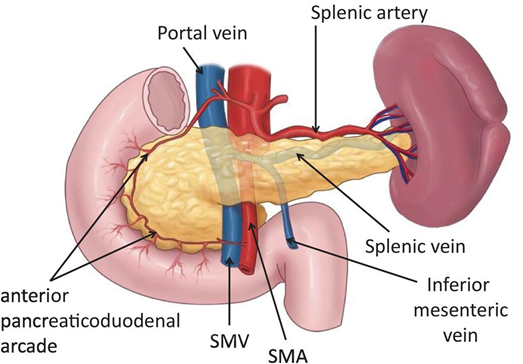
Figure 1: Anatomical relationships between the pancreatic head and the porto-mesenteric axis
Indications for Venous Resection
Current indications for venous resection are based on international guidelines, including those of the NCCN and the International Study Group of Pancreatic Surgery. Venous resection may be considered in cases of limited and reconstructible involvement of the portal vein or superior mesenteric vein, particularly following neoadjuvant therapy demonstrating tumor stability or regression [3,9].
Conversely, certain situations represent contraindications, including extensive non-reconstructible thrombosis or major associated arterial invasion. Preoperative evaluation must be multidisciplinary, integrating clinical, biological, and radiological data to avoid inappropriate indications [10,11].
Resection and Reconstruction Techniques
Venous resection techniques have been widely described and standardized over time.
- Tangential resection involves partial excision of the venous wall followed by direct closure or patch repair. It is indicated for limited involvement and is technically simpler but carries a risk of secondary stenosis [12].
- Segmental resection with end-to-end anastomosis is the most commonly used technique. It involves complete removal of the involved venous segment followed by direct reconstruction when tension is acceptable. This approach provides satisfactory oncological outcomes and restores adequate venous flow [6,13].
- Interposition graft reconstruction is required in cases of significant venous loss. Autologous grafts, such as the internal jugular vein or saphenous vein, are preferred due to better tolerance and lower infection risk. However, this technique is more complex and associated with an increased risk of thrombosis [14,15].
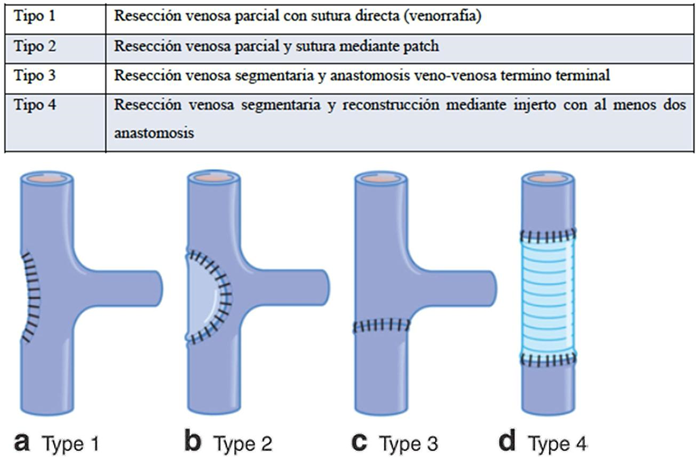
Operative Outcomes
Data from large series indicate that morbidity associated with pancreaticoduodenectomy with venous resection is comparable to that of standard surgery in high-volume centers. Specific complications include portal vein thrombosis, hemorrhage, and intestinal ischemia, although their incidence remains low under optimal conditions [2,16].
Operative mortality is currently below 5% in specialized centers, reflecting improvements in perioperative management and patient selection [5,17].
Oncological Outcomes
The primary objective of surgery remains achieving an R0 resection. Several studies have demonstrated that R0 resection rates following venous resection are comparable to those observed in patients without vascular involvement, provided adequate patient selection [6,18].
In terms of overall survival, patients undergoing venous resection have a median survival of 20–30 months, significantly higher than non-operated patients. Venous invasion itself is no longer considered an independent negative prognostic factor when complete resection is achieved [19,20].
Prognostic Factors
Several factors influence patient outcomes. Response to neoadjuvant chemotherapy is a key determinant, reflecting tumor biology. Other major prognostic factors include resection margin status, lymph node involvement, and preoperative CA19-9 levels [21,22].
Discussion
Venous resection has significantly modified the therapeutic strategy for pancreatic cancer by expanding surgical indications to patients previously considered unresectable. This evolution is part of a multimodal approach integrating neoadjuvant chemotherapy and dynamic disease assessment.
However, this strategy should not lead to over-indication. Careful patient selection remains essential to ensure real oncological benefit. Institutional experience and mastery of vascular reconstruction techniques are also critical factors in minimizing complications and optimizing outcomes.
Conclusion
Venous resection associated with pancreaticoduodenectomy is now considered a standard approach in the management of borderline pancreatic cancers in expert centers. It improves resectability rates and oncological outcomes without significantly increasing morbidity and mortality, provided that patient selection is rigorous and management is multidisciplinary
References
- Rebecca L. Siegel RL, Miller KD, Wagle NS, Jemal A. (2023). Cancer statistics, CA Cancer J Clin. 2023;73(1):17–48.
View at Publisher | View at Google Scholar - Thomas Hackert T, Sachsenmaier M, Hinz U, et al. (2016). Locally advanced pancreatic cancer: neoadjuvant therapy with FOLFIRINOX results in resectability and improved survival. Ann Surg. 264(3):457–463.
View at Publisher | View at Google Scholar - (2024). National Comprehensive Cancer Network. NCCN Clinical Practice Guidelines in Oncology: Pancreatic Adenocarcinoma. Version.
View at Publisher | View at Google Scholar - Thierry Conroy T, Desseigne F, Ychou M, et al. (2011). FOLFIRINOX versus gemcitabine for metastatic pancreatic cancer. N Engl J Med. 364(19):1817–1825.
View at Publisher | View at Google Scholar - Marcus N. Wente MN, Shrikhande SV, Müller MW, et al. (2007). Portal vein resection in pancreatic cancer surgery: a safe procedure. Ann Surg.246(5):786–795.
View at Publisher | View at Google Scholar - James F. Tseng JF, Raut CP, Lee JE, et al. (2004). Pancreaticoduodenectomy with vascular resection: margin status and survival. J Gastrointest Surg. 8(8):935–949.
View at Publisher | View at Google Scholar - Jean-Robert Delpero JR, Sauvanet A. (2010). Vascular resection for pancreatic cancer. Ann Surg;251(2):291–298.
View at Publisher | View at Google Scholar - Charlotte S. Verbeke CS, Menon KV. (2009). Redefining resection margin status in pancreatic cancer. Histopathology. 55(4):367–379.
View at Publisher | View at Google Scholar - Markus Bockhorn M, Uzunoglu FG, Adham M, et al. (2014). Borderline resectable pancreatic cancer: a consensus statement. Ann Surg Oncol. 21(9):2787–2795.
View at Publisher | View at Google Scholar - Michael P. Callery MP, Chang KJ, Fishman EK, et al. (2019). Pretreatment assessment of pancreatic cancer. Ann Surg Oncol.16(7):1727–1733.
View at Publisher | View at Google Scholar - Matthew H. Katz MH, Marsh R, Herman JM, et al. (2013). Borderline resectable pancreatic cancer: the importance of this emerging stage. J Clin Oncol.31(26):364–371.
View at Publisher | View at Google Scholar - Richard L. Smoot RL, Farnell MB, Sarr MG, et al. (2006). Resection of pancreatic cancer with venous reconstruction. Ann Surg.244(5):740–749.
View at Publisher | View at Google Scholar - Timothy J. Howard TJ, Villanustre N, Moore SA, et al. (2003). ascular reconstruction in pancreaticoduodenectomy. J Gastrointest Surg. 7(8):1089–1095.
View at Publisher | View at Google Scholar - Giovanni Illuminati G, Carboni F, Lorusso R, et al. (2008). Results of portal vein graft reconstruction. Ann Surg. 248(2):265–272.
View at Publisher | View at Google Scholar - Yong Zhou Y, Zhang Z, Liu Y, Li B, Xu D. (2012). Use of vein grafts in pancreatic surgery. Pancreas. 41(4):646–652.
View at Publisher | View at Google Scholar - Hendrik Riediger H, Keck T, Wellner U, et al. (2006). Morbidity after pancreaticoduodenectomy with venous resection. Ann Surg. 244(1):71–78.
View at Publisher | View at Google Scholar - John L. Cameron JL, He J. (2015). Two thousand consecutive pancreaticoduodenectomies. J Am Coll Surg. 220(4):530–536.
View at Publisher | View at Google Scholar - Emin F. Yekebas EF, Bogoevski D, Cataldegirmen G, et al. (2008). Long-term survival after pancreatic resection. Ann Surg. 247(2):300–309.
View at Publisher | View at Google Scholar - Hirantha P. Siriwardana HP, Siriwardena AK. (2006). Systematic review of venous resection. Eur J Surg Oncol. 32(9):939–944.
View at Publisher | View at Google Scholar - Nicolai Mollberg N, Rahbari NN, Koch M, et al. (2011). Meta-analysis of venous resection. Ann Surg. 253(5):882–893.
View at Publisher | View at Google Scholar - Cristina R. Ferrone CR, Marchegiani G, Hong TS, et al. (2015). Radiological vs pathological response. Ann Surg. 261(1):12–17.
View at Publisher | View at Google Scholar - Vincenzo P. Groot VP, Rezaee N, Wu W, et al. (2019). Patterns of failure after surgery. Ann Surg. 269(5):933–940
View at Publisher | View at Google Scholar