 Clinic
Research Article | DOI: https://doi.org/10.31579/2834-5126/093
Initiation Practices, Knowledge and Attitudes of Mothers on Infants Exclusive Breastfeeding at Daboase in The Wassa East District, Ghana
1Department of Health, Physical Education and Recreation, University of Cape Coast, Cape Coast, Ghana.
2Department of Biostatistics and Epidemiology, University of Health and Allied Sciences, Ho, Ghana.
*Corresponding Author: Anthony Edward Boakye Department of Health, Physical Education and Recreation, University of Cape Coast, Cape Coast, Ghana.
Citation: Anthony Edward Boakye, Rita Tekpertey, (2026), Initiation Practices, Knowledge and Attitudes of Mothers on Infants Exclusive Breastfeeding at Daboase in The Wassa East District, Ghana, Clinical Trials and Clinical Research,5(1); DOI:10.31579/2834-5126/093
Copyright: © 2026, Anthony Edward Boakye. This is an open access article distributed under the creative commons’ attribution license, which permits unrestricted use, distribution, and reproduction in any medium, provided the original work is properly cited.
Received: 31 December 2025 | Accepted: 15 January 2026 | Published: 20 January 2026
Keywords: attitude; breastfeeding; exclusive; feeding; infant; initiation; knowledge; practices
Abstract
Background: Infants exclusive breastfeeding remains the only imperative and befitting approach for ensuring infants below 6 months get the vital nutrients needed for optimum growth and prevent child stunting. This study investigates initiation practices, knowledge and attitude of mothers on infants exclusive breastfeeding at Daboase in the Wassa East District, Ghana.
Methods: A quantitative approach and descriptive design were used with 390 participants which made up of lactating mothers. Data were analysed using frequency distribution, Pearson’s chi-squared test of independence and binary logistic regression.
Results: Have no believe that breastfeeding provides the best nutrition for the child in the first six months was statistically significant related to infants exclusive breastfeeding at p<0.05, (OR=4.213, 95%CI ([1.270-13.980]). Have no believe that positive attitude about the benefits of infants exclusive breastfeeding for the child’s health was observed as statistically significant to infants exclusive breastfeeding at p<0.05, (OR=3.469, 95%CI[1.203-10.002]). Have no positive attitude about the benefits of infants exclusive breastfeeding for the mothers’ health was statistically significant at p<0.05, (OR=3.829, 95% CI[1.286-11.400]).
Conclusion: It is recommended that health workers should continue to educate mothers to enable them increase the proportion of infants who are breastfed exclusively in the first six months.
Introduction
With high burden of preventable causes of under-five deaths such as pneumonia and diarrhoea, promotion of optimal infant and young child feeding practices remains a priority area for intensification (Ahmed, Page, Arora & Ogbo, 2020; Ogbo, Nguyen, Naz et al., 2018). This high burden clearly calls for focus on efforts to promote infant and young child feeding practices (Adhikari et al., 2021; Karn, Devkota, Uddin et al., 2017). Breastfeeding is an important child survival intervention (Engelhart et al., 2022). Breastfeeding within an hour of birth can prevent 20% of newborn deaths (Karim et al., 2018; Phukan, Ranjan & Dwivedi, 2018). Babies, who are exclusively breastfed in the first six months of age, are 11 times less likely to die from diarrhoea and 15 times less likely to die from pneumonia, two leading causes of death in children under-five years of age (Hossain & Mihrshahi, 2022; Mulatu, Yimer, Alemnew, Linger & Liben, 2021). An infant’s water requirement for the first 6 months is totally met by mother’s milk (Motee & Jeewon, 2014; Suzan et al., 2023). Giving water leads to reduced desire to suckle and poses a risk factor for contracting infections. Early initiation of breastfeeding is extremely important for establishing successful breastfeeding practices. It also helps in better bonding and early milk flow. Babies are normally very alert and responsive within one hour after delivery and are ready to suckle and attach to the breast easily (Dukuzumuremyi, Acheampong, Abesig et al., 2020; Gavine et al., 2022). An early start also provides the benefits of colostrum (first few days milk after delivery) to the baby (Gavine et al., 2022). Breastfeeding protects infants against diarrhoea and common childhood illnesses such as pneumonia, and may also have longer-term health benefits for the infant [which includes reducing the risk of overweight and obesity in childhood and adolescence] (Hamer et al., 2022; Roldão et al., 2024). The Ghana Demographic and Health Survey has submitted that there has been notable progress in breastfeeding practices. For instance, early breastfeeding initiation has increased from 52% to 58%, and exclusive breastfeeding rates have risen from 52% to 53.1%. However, the coverage is expected to surpass 70% in both indicators (Ghana Statistical Service [GSS] & ICF, 2024). Infants exclusive breastfeeding [IEBF] remains the only imperative and befitting approach for ensuring infants below 6 months get the vital nutrients needed for optimum growth and prevent child stunting (Dukuzumuremyi, Acheampong, Abesig et al., 2020; Hadi et al., 2021). It helps in reducing infant mortality due to childhood illnesses such as diarrhoea or pneumonia, and helps for a quicker recovery during illness. Infants below 6 months are considered not fully developed to make use of other foods aside breastmilk. Hence, the recommendation to encourage IEBF for all children under six months old (Jama, Gebreyesus, Wubayehu et al., 2020). However, IEBF in most cases has achieved less than desired outcomes (Diji et al., 2017; Koffi, Essis, Bamba et al., 2023; Mensah et al., 2017). Most health care advocates with their concerns towards the needs of the individual breastfeeding mothers without taking into account the wider impact of initiation practices, knowledge and attitude of these breastfeeding mothers on how they make decisions concerning Infants exclusive breastfeeding (Alnasser et al., 2018; Dukuzumuremyi, Acheampong, Abesig et al., 2020; Radzyminski & Callister, 2015). A search from electronic databases and library revealed several studies on the phenomena under study. However, the numerous studies were limited in coverage. For instance, Walker (2010) studied how exclusive breastfeeding in the first six months of life prevents diarrhoeal diseases, acute respiratory diseases as well as improved stunting among children, Vennemann (2009) looked at how breastfeeding can protects infants against sudden death syndrome, Black et al. (2008) studied the outcome of mothers that introduced other foods to infants before six months either than the exclusive breastfeeding. Though, it appears significant studies have been done on infants breastfeeding among mothers, but the effect of initiation practices, mother’s knowledge levels and attitude is understudied across Ghana. Hence, this study. The purpose of the study is to examine the initiation practices, knowledge and attitudes of mothers on infants exclusive breastfeeding at Daboase in the Wassa East District, Ghana by specifically: assessing if mothers’ initiation practices influence infants exclusive breastfeeding at Daboase in the Wassa East District, Ghana, ascertaining whether mothers’ level of knowledge predicts infants exclusive breastfeeding at Daboase in the Wassa East District, Ghana and lastly, examining if mothers’ attitude influences IEBF at Daboase in the Wassa East District, Ghana. The study further hypothesised that there is no statistically significant relationship between initiation practices, mothers’ level of knowledge as well as mothers’ attitudes and IEBF.
Conceptual Framework
The conceptual framework (see Figure 1) brought to the fore that initiation practices, maternal knowledge and attitude are all determinants that motivate mothers to engage in infants exclusive breastfeeding. The framework has depicted that for mothers to be more proactive to engage in IEBF will largely depend upon one’s knowledge, attitude and the initiation practices. Knowledge and attitude of mothers about infants exclusive breastfeeding can be developed by conscious effort made by mother and these can be ascertained by further research on the underlying factors affecting IEBF. The conceptual framework is used to give a justification to the study. Hence, providing a comprehensive understanding to the study with direction towards the interpretation of the study results. The framework will also help the researchers to understand the relative importance of the factors and how they interact to influence IEBF among mothers.
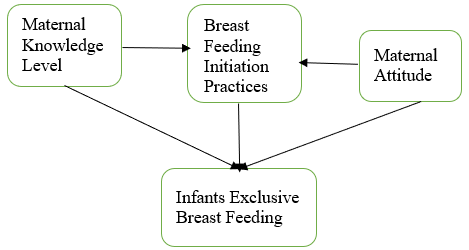
Figure 1: Conceptual Framework Illustrating how the various Explanatory variables relate to each other and the influence they exert on Infants’ Exclusive Breastfeading.
Source: Authors’ construction (2019)
Methods
Study Setting and Participants
The study was conducted at Daboase in the Wassa East District, Ghana. Daboase was chosen because it recorded timely initiation of infants exclusive breastfeeding at 3 months coverage of 99.3% while the district recorded 99.1%. Child stunting coverage of 0.40% while analysis of underweight among attendance 0 – 59 months in the district was 0.10% (Wassa East District Assembly, 2023). The study enrolled 390 breastfeeding mothers with children age less than 24 months.
Study Design and Data Source
The study was conducted cross-sectionally and lends itself to the use of both quantitative approach and descriptive design. The study adopted quantitative approach because it helps researchers to gain precise understanding using numerical data about phenomena under study (Capili, 2021; Noyes et al., 2019). The cross-sectional nature of the study allows the researchers to collect data from respondents at a single point in time. The cross-sectional plan was used because the researchers did not want to influence the observe variables (Setia, 2016). Data was solicited from 390 breastfeeding mothers at Daboase.
Sampling Procedures
The study made used of simple random sampling technique. With this technique, each participant included in the sample was given equal chance of inclusion in the study (Elfil & Negida, 2017). Because the population is homogeneous, the study adopted this technique hence, it provides accurates and better estimates of parameters (Martínez-Mesa et al., 2016).
Sampling Size Determination
Yamane (1964) sample size determination formula was adopted. It is giving as n=N/((1+N〖(e)〗^2 )
Where:
Capital N is the population size, small n is the sample size and e is the precise amount. The research used 95% confidence and 5?curacy with respect to the social sciences; this was achieved accordingly;
n= 15,000
1+15,000(0.05)2 n=390
390 participants were sampled to complete the research questionnaire.
Eligibility criteria
Inclusion criteria
Breastfeeding mothers of children less than 24 months and lived at Daboase.
Exclusion criteria
Breastfeeding mothers of children older than 24 months as well as breastfeeding mothers who do not live at Daboase.
Data Collection Procedure
The data collection took place on 23rd of February, 2019 to 22nd of March, 2019 with the help of two research assistants. In all, one month was used to collect the data.
Variable Constructs
Infants exclusive breastfeeding constructs are: currently breastfeeding, child has had breast milk in the past 23 hours and child has not received any other solids, semi-solids, or solid foods in the last day and night prior to the interview (WHO, n.d). Mothers’ infants exclusive brestfeeding knowledge level constructs are: heard about exclusive breastfeeding, source of knowledge, have adequate knowledge about infants exclusive breastfeeding, had education on infants exclusive breastfeeding, infants exclusive breastfeeding educator, when to introduce complementary feeding, number of times to breastfeed in a day, breast milk being sufficient for the infant, duration of practice of exclusive breastfeeding, breast milk constains antibodies, breast milk protect both babyhood and mothers’ diesases, avoid breastfeeding when sick (Cascone, Tomassoni, Napolitano & Di Giuseppe, 2019). Initiation practices constructs are: time to start breastfeeding after birth, breastfeeding motivator, practice exclusive breastfeeding, exclusive breastfeeding challenges, how newborns are breastfed during hospitalization and women receive advice during hospital discharge (Cascone et al., 2019). Mothers’ attitude towards exclusive breastfeeding constructs are: perceived benefits of exclusive breastfeeding, perceived barriers to exclusive breastfeeding and on demand, self-confidence in expressing and storing breast milk for child (Gebretsadik, Tadesse, Mamo, Adhanu & Mulugeta, 2022).
Validity and Reliability
To ensure validity, previous standardised survey instruments on the subject matter were reviewed and those deemed appropriate were extracted to compile the current instrument for the the study. Effort was made to ensure that the key tool meets the inner coherence requirements. Therefore, Cronbach Alpha coefficient of 0.70 was used as the benchmark to access the internal consistency (Hair et al., 2010). Hence, this will satisfy that the data remarkably satisfy the assumption of reliability. Due to this, the study pre-tested the questionnaire on fifty respondents to help improve upon the clarity and understanding of the items hence, reliability.
Data Analysis
Data were processed using Statistical Package for Social Sciences version 27 (SPSS IBM Inc Chicago, USA). Frequency distribution was used to summarise information on participants’ sociodemographic characteristics, knowledge level on breastfeeding, initiation practices of breastfeeding as well as infants exclusive breastfeeding. Pearson Chi-squared test of independence was used to test the hypotheses postulated in the study to either approve or disprove the null hypothses. Binary logistic regression was conducted to ascertain among the various indicators those that predict and those that do not predict infants exclusive breastfeeding.
Ethical Considerations
Ethical approval to conduct this study was obtained from Kwame Nkrumah University of Science and Technology, the Committee on Human Research, Publication and Ethics with ID CHRPE/AP/040/19. In the field, permission was sought from the Physician Assistants at the various Health Centres at Daboase. Again, verbal consent was obtained from mothers before the commencement of the data collection. Because verbal consent was sought, it was not documented but was witnessed by participants’ relatives. Participants were also told that they can withdraw at any point even if data collection has commenced. Participants were intimated that participation was completely voluntary and they were assured of their confidentiality throughout the study.
Results
Socio-Demographic Characteristics of Participants
Table 1 presents the socio-demographic characteristics of participants. About sixty-one per cent (60.5%) of the participants in the sample were less than 20 years while 1.3% were 30-39years. Regarding mother’s employment status, employed category dominant constituting 60.5% while unemployed category was the least (1.3 %). Whereas participants with basic education were about 61 per cent (60.5%) constituting the majority, the least was SHS (1.3%). In terms of marital status, never married dominated 60.5% while 1.3% were divorced. Concerning mode of delivery about sixty-two per cent (61.8%) of the participants had normal delivery. Whereas 60.5?livered in the government hospital 1.3?livered in the private hospital. Regarding sex of the infant, 61.8% were male. In terms of age of infants, about sixty-one per cent (60.5%) were 7-9months old while 1.3% were 1-3months old.
Socio-Demographic Characteristics | F | % |
Mother’s age in years |
|
|
Less than 20 | 236 | 60.5 |
20-29 | 149 | 38.2 |
30-39 | 5 | 1.3 |
Mother’s employment status |
|
|
Employed | 236 | 60.5 |
Self-employed | 149 | 38.2 |
Unemployed | 5 | 1.3 |
Mother’s education |
|
|
None | 149 | 38.2 |
Basic | 236 | 60.5 |
SHS | 5 | 1.3 |
Mother’s marital status |
|
|
Never married | 236 | 60.5 |
Co-habiting | 149 | 38.2 |
Divorced | 5 | 1.3 |
Mode of delivery |
|
|
Normal delivery | 241 | 61.8 |
Caesarean section | 149 | 38.2 |
Table 1 Continued.
Place of delivery |
|
|
Private hospital | 5 | 1.3 |
Government hospital | 236 | 60.5 |
Traditional birth attendant | 149 | 38.2 |
Child’s sex |
|
|
Male | 241 | 61.8 |
Female | 149 | 38.2 |
Child’s age in months |
|
|
1-3months | 5 | 1.3 |
4-6months | 149 | 38.2 |
7-9months | 236 | 60.5 |
Total | 390 | 100.0 |
Table 1: Socio-Demographic Characteristics of Respondents.
Source: Fieldwork (2020)
To tackle research objective one which is “assessing if mothers’ initiation practices influence infants exclusive breastfeeding [IEBF]” made me asked series of questions ranging from “time to initiate breastfeeding, stimulants to your breastfeeding, challenges of breastfeeding, how new borns are breastfed during hospitalisation, and whether mothers receive advise after hospital discharged.” The results are shown in Table 2.
Variable | F | % |
When to initiate breastfeeding after birth |
|
|
Within an hour | 390 | 100.0 |
Who influences you to practice breastfeeding |
|
|
Husband | 5 | 1.3 |
Health worker | 385 | 98.7 |
Experienced any problem of breastfeeding |
|
|
Yes | 352 | 90.3 |
No | 38 | 9.7 |
How new borns are breastfed during hospitalization |
|
|
Child only receive breast milk | 346 | 88.7 |
Child receive both breast milk and formula | 20 | 5.1 |
Receive only formula | 24 | 6.2 |
Mothers’ receive advise during hospital discharge |
|
|
Yes | 374 | 95.9 |
No | 16 | 4.1 |
Total | 390 | 100.0 |
Table 2: Mothers’ Initiation Practices of Infants Breastfeeding.
Source: Fieldwork (2020)
When mothers were asked to indicate the appropriate time to initiate breastfeeding after birth revealed that all mothers reported that it is within an hour (see Table 2). Regarding the person who influences the mothers to practise breastfeeding shows that overwhelming majority (98.7%) of the mothers indicated that it is a health worker (see Table 2). When mothers were asked to indicate whether they had ever experienced any breastfeeding problem or not, the result shows that majority (90.3%) of the mothers answered in affirmative (see Table 2). Among the 352 mothers that reported that they had ever experienced breastfeeding problem were further asked to indicate the kind of problem they ever experienced and the result indicated that 92.0% of the mothers experienced abscess, 4.3% experienced sore/cracked nipples while 3.7% experienced mastitis. Whereas 88.7% of the mothers indicated that new borns only receive breast milk during hospitalization 5.1% reported that new borns receive both breastmilk and formula during hospitalisation (see Table 2). On whether mothers’ receive advise during hospital discharge or not, the result indicated that overwhelming majority (95.9%) of the mothers answered in affirmative (see Table 2). Among the 374 mothers that confirmed they receive advise after hospital discharged were further asked to identify the kind of advise they receive and nearly ninety-three per cent (92.5%) reported they receive advise on exclusive breastfeeding while 7.5% said they receive advise on both exclusive breastfeeding and formula milk. To identify among the mothers who practice infants exclusive breastfeeding, they were asked some specific questions and the results are presented in Table 3.
Variable | F | % |
Practice infants exclusive breastfeeding |
|
|
Yes | 338 | 86.7 |
No | 52 | 13.3 |
Total | 390 | 100.0 |
Table 3: Infants Exclusive Breastfeeding Practices.
Source: Fieldwork (2020)
When respondents were asked to indicate whether they practice infants exclusive breastfeeding or not, the result revealed that 86.7% of the respondents reported in affirmative while 13.3% indicated they do not practice infants exclusive breastfeeding (see Tale 3). Among the 338 respondents who confirmed they practice infants exclusive breastfeeding, all of them (100.0%) said they breastfed the child during the last 23 hours prior to the interview. All the respondents (100.0%) said their child did not receive any other solids, semi-solids or solid food in the last day and night prior to the interview. In Table 4 has Pearson’s chi squared test of independence results on the relationship between mothers’ initiation practices and infants exclusive breastfeeding. This analysis was conducted to test the hypothesis there is no statistically significant relationship between mothers’ initiation practices and exclusive breastfeeding. Statistically significant relationships were found among mothers’ ever experienced infants breastfeeding problem [p=0.011], mothers’ breastfeeding problem ever experienced [p=0.072], new borns feeding during hospitalisation [p=0.022] and infants exclusive breastfeeding. However, statistically relationships were not found among mothers’ receive advise during hospital discharge [p=0.109], the kind of advise mothers’ receive [p=0.100] as well as who influences mothers’ initiation practices [p=0.377] and infants exclusive breastfeeding.
Variable | Practice EBF (%) | Not Practice EBF (%) | Total n(%) | Chisquare | P Value |
Who influences you to practice breastfeeding |
|
|
| 0.779 | 0.377 |
Husband | 100.0 | 0.0 | 5(100.0) |
|
|
Health worker | 86.5 | 13.5 | 385(100.0) |
|
|
Ever experience breastfeeding problem |
|
|
| 6.477** | 0.011 |
Yes | 85.2 | 14.8 | 352(100.0) |
|
|
No | 100.0 | 0.0 | 38(100.0) |
|
|
Breastfeeding problem ever experienced |
|
|
| 5.273* | 0.072 |
Abscess | 84.0 | 16.0 | 324(100.0) |
|
|
Mastitis | 100.0 | 0.0 | 13(100.0) |
|
|
Sore/cracked nipples | 100.0 | 0.0 | 15(100.0) |
|
|
New borns feeding during hospitalization |
|
|
| 7.630** | 0.022 |
Child only receive breast milk | 85.0 | 15.0 | 346(100.0) |
|
|
Child receive both breast milk and formula | 100.0 | 0.0 | 20(100.0) |
|
|
Child receive only formula | 100.0 | 0.0 | 24(100.0) |
|
|
Receive advise during hospital discharge |
|
|
| 2.567 | 0.109 |
Yes | 86.1 | 13.9 | 374(100.0) |
|
|
No | 100.0 | 0.0 | 16(100.0) |
|
|
Kind of advise mothers receive during hospital discharge |
|
|
| 2.699 | 0.100 |
Receive advise on breastfeeding | 85.3 | 14.7 | 346(100.0) |
|
|
Receive advise on both breastfeeding and formula | 96.4 | 3.6 | 28( 100.0) |
|
|
Table 4: Relationship between Mothers’ Initiation Practices and Infants Exclusive breastfeeding.
Note: Row percentages in parenthesis, Chi-square significant at (0.01)***, (0.05)**, (0.10)*
Source: Fieldwork (2020).
To find data for research objective two which is “ascertaining whether mothers’ level of knowledge predicts infants exclusive breastfeeding at Daboase in the Wassa East District, Ghana.” A number of questions were asked ranging from “ heard about infant exclusive breastfeeding [IEBF], where heard IEBF from, had education on IEBF, the person who educate you on IEBF, source of the IEBF education, age of infant to introduce complementary food, number of times to breastfeed a child per day, breast milk is sufficient for the first six months, IEBF be practice at least six months, etc. and the results were presented in Table 5.
Variable | F | % |
Heard about infant exclusive breastfeeding |
|
|
Yes | 390 | 100.0 |
Source of knowledge about infant exclusive breastfeeding |
|
|
Hospital | 4 | 1.0 |
Clinic | 156 | 40.0 |
Radio | 230 | 59.0 |
Had education on infant exclusive breastfeeding |
|
|
Yes | 390 | 100.0 |
Who educated you on infant exclusive breastfeeding |
|
|
Health worker | 375 | 96.2 |
Relatives | 10 | 2.6 |
Friend | 5 | 1.3 |
Appropriate time to introduce complementary feeding |
|
|
Six months and above | 390 | 100.0 |
Have adequate knowledge about infant exclusive breastfeeding |
|
|
Yes | 376 | 96.4 |
No | 14 | 3.6 |
Number of times to breastfeed an infant in a day |
|
|
3-4times | 236 | 60.5 |
5-6times | 149 | 38.2 |
Upon demand | 5 | 1.3 |
Breastmilk is sufficient for child for the first six months |
|
|
Yes | 364 | 93.3 |
|
|
|
No | 26 | 6.7 |
Know that IEBF should be practice atleast six months |
|
|
Yes | 363 | 93.1 |
No | 27 | 6.9 |
Breastmilk contains antibodies that are transferred to thechild |
|
|
Yes | 154 | 39.5 |
No | 236 | 60.5 |
Breastmilk protect babies against infectious diseases |
|
|
Yes | 154 | 39.5 |
No | 236 | 60.5 |
Breastfeeding protects mothers’ from cancer |
|
|
Yes | 154 | 39.5 |
No | 236 | 60.5 |
Total | 390 | 100.0 |
Table 5: Mothers’ Level of Knowledge about Infants Exclusive Breastfeeding.
Source: Fieldwork (2020)
When respondents were asked to indicate whether they have heard about infant exclusive breastfeeding or not, the result shows that all respondents (100.0) answered in affirmative (see Table 5). Regarding respondents source of knowledge about infant exclusive breastfeeding, 59.0% of the respondents indicated that it is the radio while 40.0% said it is the clinic (see Table 5). When asked whether respondents have had education on infant exclusive breastfeeding or not, all the respondents (100.0%) answered in affirmative (see Table 5). Concerning the person who educated the respondents on infant exclusive breastfeeding, little above ninety-six per cent (96.2%) indicated health worker while 1.3% reported friends. All the respondents (100.0%) reported that the appropriate time to introduce complementary feeding is six months and above (see Table 5). Whereas 96.4% said they have had adequate knowledge about infant exclusive breastfeeding 3.6% reported that they have not had adequate knowledge about infants exclusive breastfeeding. Regarding the number of times to breastfeed an infant in a day, about sixty-one per cent (60.5%) of the respondents said it is 3-4times while 1.3% indicated that it is upon demand (see Table 5). When respondents were asked whether breastmilk is sufficient for a child for the first six months or not, 93.3% of the respondents answered in affirmative while 6.7% said it is not sufficient for the child for the first six months (see Table 5). When respondents were asked to indicate whether infants exclusive breastfeeding be practice atleast six months or not, 93.1% answered in affirmative while 6.9% reported that they do not know that infants exclusive breastfeeding should be practice atleast for the first six months (see Table 5). On whether breastmilk contains antibodies that are transferred to the babies or not, 60.5% of the respondents indicated that breastmilk does not contains antibodies while 39.5% said it contains antibodies (see Table 5). Regarding whether breastmilk protect babies against infectious diseases or not, 60.5% of the respondents said it does not while 39.5% reported that it does. On whether breastfeeding protects mothers’ from cancer or not, 60.5% of the respondents said it does not while 39.5% said it does (see Table 5). Table 6 presents results on Peason’s chi-squared test of independence. This analysis was run to test the hypothesis there is no statistically significant relationship between mothers’ level of knowledge and infants exclusive breastfeeding. Statistically significant relationship was found between breastmilk is sufficient for a child for the first six months [p=0.038] and infant exclusive breastfeeding. However, statistically significant relationships were not found among source of knowledge [p=0.607], IEBF educator [p=0.301], have adequate knowledge about infants exclusive breastfeeding [p=0.135], know that infants exclusive breastfeeding be practice for atleast six months [p=0.814], breastmilk contains antibodies that are transferred to the baby [p=0.640], breastmilk protects babies against infectious diseases [p=0.640], breastfeeding protects mothers against breast cancer [p=0.640] and infants exclusive breastfeeding.
Variable | Practice IEBF (%) | Not practice IEBF (%) | Total n (%) | Chi-square | P-value |
Source of knowledge about IEBF |
|
|
| 1.000 | 0.607 |
Hospital | 100.0 | 0.0 | 4(100.0) |
|
|
Clinic | 87.8 | 12.2 | 156(100.0) |
|
|
Radio | 85.7 | 14.3 | 230(100.0) |
|
|
IEBF educator |
|
|
| 2.400 | 0.301 |
Health worker | 86.1 | 13.9 | 375(100.0) |
|
|
Relatives | 100.0 | 0.0 | 10(100.0) |
|
|
Friend | 100.0 | 0.0 | 5(100.0) |
|
|
Have adequate knowledge about IEBF |
|
|
| 2.234 | 0.135 |
Yes | 86.2 | 13.8 | 376(100.0) |
|
|
No | 100.0 | 0.0 | 14(100.0) |
|
|
Table 6: Relationship Between Mothers’ Level of Knowledge and Infants Exclusive Breastfeeding.
Number of times to breastfeed in a day |
|
|
| 0.899 | 0.638 |
3-4times | 86.0 | 14.0 | 236(100.0) |
|
|
5-6times | 87.2 | 12.8 | 149(100.0) |
|
|
Upon demand | 100.0 | 0.0 | 5(100.0) |
|
|
Breastmilk is sufficient for a child for the first six months |
|
|
| 4.286** | 0.038 |
Yes | 85.7 | 14.3 | 364(100.0) |
|
|
No | 100.0 | 0.0 | 26(100.0) |
|
|
IEBF be practice for the first six months |
|
|
| 0.055 | 0.814 |
Yes | 86.8 | 13.2 | 363(100.0) |
|
|
No | 85.2 | 14.8 | 27(100.0) |
|
|
Breastmilk contains antibodies that are transferred to the child |
|
|
| 0.218 | 0.640 |
Yes | 87.7 | 12.3 | 154(100.0) |
|
|
No | 86.0 | 14.0 | 236(100.0) |
|
|
Breastmilk protects babies against infectious diseases |
|
|
| 0.218 | 0.640 |
Yes | 87.7 | 12.3 | 154(100.0) |
|
|
No | 86.0 | 14.0 | 236(100.0) |
|
|
Breastfeeding protects mothers against breast cancer |
|
|
| 0.218 | 0.640 |
Yes | 87.7 | 12.3 | 154(100.0) |
|
|
No | 86.0 | 14.0 | 236(100.0) |
|
|
Table 6: Continued.
Note: Row percentages in parenthesis, Chi-square significant at (0.01) ***, (0.05) **, (0.10) *
Source: Fieldwork (2020).
To solicit for data on mothers’ attitude towards infants exclusive breastfeeding, a number of questions were asked and the results are presented in Table 7.
Variable | F | % |
Believe that breastfeeding provides the best nutrition for the child in the first six months |
|
|
Yes | 373 | 95.6 |
No | 17 | 4.4 |
Believe that breastfeeding creates a bond between mothers and infants |
|
|
Yes | 355 | 91.0 |
No | 35 | 9.0 |
Table 7: Mothers’ Attitude towards Infants Exclusive Breastfeeding.
Have positive attitude about the benefits of IEBF for the child’s health |
|
|
Yes | 367 | 94.1 |
No | 23 | 5.9 |
Have positive attitude about the benefits of IEBF for the mothers’ health |
|
|
Yes | 372 | 95.4 |
No | 18 | 4.6 |
Yes | 369 | 94.6 |
No | 21 | 5.4 |
Have perceived barriers to IEBF and breastfeeding upon demand |
|
|
Yes | 375 | 96.2 |
No | 15 | 3.8 |
Total | 390 | 100.0 |
Table 7: Continued.
Source: Fieldwork (2020)
When respondents were asked whether they believe that breastfeeding provides the best nutrition for the child in the first six months or not, the result shows that 95.6% of the respondents answered in affirmative (see Table 7). Regarding whether respondents believe that breastfeeding creates a bond between mothers and infants or not, the result revealed that majority 91.0% of the respondents reported that breastfeeding creates a bond between mothers and infants (see Table 7). Whereas 94.1% of the respondents have positive attitude about the benefits of infants exclusive breastfeeding for the child’s health 5.9% of the respondents were not in tune to that (see Table 7). Concerning whether respondents have positive attitude about the benefits of infants exclusive breastfeeding for the mothers’ health or not, revealed that 95.4% of the respondents answered in affirmative while 4.6% of the respondents have no positive attitude about the benefits of infants exclusive breastfeeding for the mothers’ health (see Table 7). Respondents were asked if they have perceived benefits of infants exclusive breastfeeding for the mothers’ health or not, the result shows that 94.6% of the respondents answered in affirmative while 5.4% of the respondents were not on the same page (see Table 7). Whereas 96.2% of the respondents reported they have perceived barriers to infants exclusive breastfeeding and breastfeeding upon demand 3.8% of the respondent did not have perceived barriers to infants exclusive breastfeeding and breastfeeding upon demand (see Table 7). In Table 8 has the Pearson’s chi-square test of independence. This analysis was conducted to test the hypothesis there is no statistically significant relationship between mothers’ attitude and infants exclusive breastfeeding. Statistically significant relationships were found amond all the variables studied under mothers’ attitude. Namely: believe that breastfeeding provides the best nutrition for the child in the first six months [p=0.046], believe that breastfeeding creates a bond between mothers and infants [p=0.082], have positive attitude about the benefits of IEBF for the child’s health [P=0.013], have positive attitude about the benefits of IEBF for the mothers’ health [p=0.001], have perceived benefits of IEBF [p=0.001] as well as have perceived barriers to IEBF and breastfeeding upon demand [p=0.001] and infants exclusive breastfeeding.
Variable | PracticeIEBF | Not practice IEBF | Total n (%) | Chi-square | P-value |
Believe that breastfeeding provides the best nutrition for the child in the first six months |
|
|
| 3.977 | 0.046 |
Yes | 87.4 | 12.6 | 373(100.0) |
|
|
No | 70.6 | 29.4 | 17(100-0) |
|
|
Believe that breastfeeding creates a bond between mothers and infants |
|
|
| 3.018 | 0.082 |
Yes | 87.6 | 12.4 | 355(100.0) |
|
|
No | 77.1 | 22.9 | 35(100.0) |
|
|
Have positive attitude about the benefits of IEBF for the child’s health |
|
|
| 6.186 | 0.013 |
Yes | 87.7 | 12.3 | 367(100.0) |
|
|
No | 69.6 | 30.4 | 23(100.0) |
|
|
Table 8: Relationship between Mothers’ Attititude and Infants Exclusive Breastfeeding.
Have positive attitude about the benefits of IEBF for the mothers’ health |
|
|
| 15.806 | 0.001 |
Yes | 88.2 | 11.8 | 374(100.0) |
|
|
No | 55.6 | 44.4 | 18(100.0) |
|
|
Have perceived benefits of IEBF |
|
|
| 16.742 | 0.001 |
Yes | 88.3 | 11.7 | 369(100.0) |
|
|
No | 57.1 | 42.9 | 21(100.0) |
|
|
Have perceived barriers to IEBF and breastfeeding upon demand |
|
|
| 15.000 | 0.001 |
Yes | 88.0 | 12.0 | 375(100.0) |
|
|
No | 53.3 | 46.7 | 15(100.0) |
|
|
Table 8: Continued.
Note: Row percentages in parenthesis, Chi-square significant at (0.01) ***, (0.05) **, (0.10) *
Source: Fieldwork (2020).
Further analysis was run to ascertain which variables among the components studied under mothers attitude those that are predictors and those that are not predictors to infants exclusive breastfeeding. The results are presented in Table 9.
Variable | Odds ratio | P-value | 95 CI | |
Believe that breastfeeding provides the best nutrition for the child in the first six months (Yes=1.0) |
|
|
|
|
No | 4.213 | 0.019 | 1.270 | 13.980 |
Believe that breastfeeding creates a bond between mothers and infants (Yes=1.0) |
|
|
|
|
No | 1.359 | 0.549 | 0.499 | 3.7.7 |
Have positive attitude about the benefits of IEBF for the child’s health (Yes=1.0) |
|
|
|
|
No | 3.469 | 0.021 | 1.203 | 10.002 |
Have positive attitude about the benefits of IEBF for the mothers’ health (Yes=1.0) |
|
|
|
|
No | 3.829 | 0.016 | 1.286 | 11.400 |
Have perceived benefits of IEBF (Yes=1.0) |
|
|
|
|
No | 4.904 | 0.002 | 1.752 | 13.727 |
Have perceived barriers to IEBF and breastfeeding upon demand (Yes=1.0) |
|
|
|
|
No | 5.824 | 0.003 | 1.806 | 18.780 |
Table 9: Binary Logistic Regression Results on Mothers Attitude and Infants Exclusive Breastfeeding.
Source: Field work (2020), significant at (0.05)
It emerged in Table 9 that, have no believe that breastfeeding provides the best nutrition for the child in the first six months was statistically significant related to infants exclusive breastfeeding at p<0.05, (OR=4.213, 95%CI ([1.270-13.980]). It was observed that mothers that reported that they do not believe that breastfeeding provides the best nutrition for the child in the first six months were 4.2 times more likely to practice infants exclusive breastfeeding relatively to those mothers that intimated they believe breastfeeding provides the best nutrition for the child in the first six months (see Table 9). Have no believe that positive attitude about the benefits of IEBF for the child’s health was observed as statistically significant to infants exclusive breastfeeding at p<0.05, (OR=3.469, 95%CI[1.203-10.002]). This identifies those mothers who have no positive attitude towards the benefits of IEBF for the child’s health were 3.5 times more likely to practice infants exclusive breastfeeding compare to those mothers that have positive attitude about the benefits of IEBF for the child’s health (see Table 9). Have no positive attitude about the benefits of IEBF for the mothers’ health was statistically significant at p<0.05, (OR=3.829, 95%CI[1.286-11.400]). This signifies that those mothers were 3.8 times more likely to practice infants exclusive breastfeeding relatively to those mothers that said have positive attitude about the benefits of IEBF for the mothers’ health (see Table 9). Have no perceived benefits of IEBF was observed to be statistically significat at p<0.05, (OR=4.904, 95%CI[1.752-13.727]). This highlights mothers who said they have no perceived benefits of IEBF as 4.9 times more likely to practice infants exclusive breastfeeding compare to those mothers that reported they have perceived benefits of IEBF. (see Table 9). Have no perceived barriers to IEBF and breastfeeding upon demand was statistically significant at p<0.05, (OR=5.824, 95%CI[1.806-18.780]). This postulates that mothers that have no perceived barriers to IEBF and breastfeeding upon demand werew 5.8 times more likely to practice infants exclusive breastfeeding compare to those mothers that said they have perceived barriers to IEBF and breastfeeding upon demand.
Discussion
The study aimed at understanding the initiation practices, knowledge and attitudes of mothers on infants exclusive breastfeeding. Therefore, the discussion is depended on some selected variables studied under each factor, the literature review, as well as the conceptual framework of the study.
Mothers’ Initiation Practices of Infants Breastfeeding
Mothers demonstrated utmost knowledge and understanding of initiation practices of infants breastfeeding. Per the views of mothers, the appropriate time to initiate breastfeeding after birth is within an hour. These mothers were influenced by a health worker to practice breastfeeding. These findings have revealed that mothers are aware that if infants are not fed within an hour after birth, it might affect the bond the (infants) might have with them (mothers). It could also mean that mothers know that early initiation of breastfeeding is really significant for establishing effective breastfeeding practices. This finding confirms Ekubay, Berhe and Yisma’s (2018) study that, mothers who breastfed their infants initiated breastfeeding within one hour of birth. Mothers being influenced by health workers implies that, mothers attend antenatal care anytime they are pregnant. It could also mean that, health workers discharge their duties well during antenatal care services. Mothers that reported that they had ever experienced breastfeeding problem reason could be that they might have their infants at heart and that they do well to breastfeed them continuously which is why they do encounter such problems. This finding is in line with a study by Babakazo, Bosonkie, Mafuta, Mvuama and Mapatano (2022) that lactating mothers experience several problems. Overwhelming mothers reported that new borns only receive breast milk during hospitalization. The reason for this finding could be that those mothers practice exclusive breastfeeding and that might not want to introduce any complementary food when it is not six months. Similarly, it could probably be that those mothers have sufficient breastmilk to feed the child which is why they only feed them with only breast milk. This finding is in line with Giang, Duy, Vuong et al.’s (2022) study that being born in district hospitals were associated with increased prevalence of exclusive breastfeeding during hospital stay. Mothers’ confirmed that they receive advise during hospital discharge. The reason for this finding could probably be that those mothers often vist a healthcare facility that have compentent staff and understand their work well. Statistically significant relationship was found between mothers’ initiation practices and infants exclusive breastfeeding therefore, the null hypothesis was not confirmed. This finding has demonstrated that the more and more mothers initiate breastfeeding practices early, it is the more and more it increases infants being exclusively breastfed. This finding is in line with Ulfa, Maruyama, Igarashi and Horiuchi’s (2023) study that most studies suggest that successful early initiation of breastfeeding is associated to exclusive breastfeeding at one and three months.
Mothers’ Level of Knowledge about Infants Exclusive Breastfeeding
It was revealed in the study that all the respondents have heard about infant exclusive breastfeeding. This finding has shown that respondents are abreast of information about exclusive breastfeeding and the most cited source of their knowledge about infant exclusive breastfeeding was the radio which might implies that those respondents are responsive to news and are good listners of radio. However those that cited the clinic as the source of their knowledge about exclusive breastfeeding reason could be that they have been visiting the clinic anytime they become pregnant and the nurses that are incharge of their services do educate them about exclusive breastfeeding. This finding is in line with Nukpezah, Nuvor and Ninnoni’s (2018) study that many mothers have heard about exclusive breastfeeding. The study identifies that all the respondents have had education on infant exclusive breastfeeding. The most cited educator for the exclusive breastfeeding education was the health worker. It could be said that health workers and mothers are always in tune which made it possible for health workers to find it easier to educate mothers on exclusive breastfeeding without a hitch. Almost all the respondents intimated that they have had adequate knowledge about infant exclusive breastfeeding. The reason to this finding could probably be that educators of this exclusive breastfeeding are endowed with much expertise in exclusive breastfeeding which is why mothers could own out to say that they have adequate knowledge about exclusive breastfeeding. This finding corroborates to a study by Agyekum, Codjoe, Dake and Abu (2022) that some mothers are taught how to breastfeed their babies during postnatal and antenatal clinics visit by health workers. All the respondents sampled for the study were of the view that the appropriate time to introduce complementary feeding is six months and above with the number of times to breastfeed in a day being 3-to-4times. The reason for this finding could probably mean that health workers have educated mothers on the appropriate time to introduce complementary feeding. It could probably mean that mothers have witnessed the benefits of exclusive breastfeeding and that are aware of when to substitute solid food instead of breastmilk. This finding confirms Mohammed, Getinet, Solomon et al.’s (2018) study that thus, 6 months of age is the appropriate age to introduce complementary foods. The three-to-four times respondents said an infant should be breastfed might probably mean that they do not have time for the child and that could only feed their child three-to-four times in a day. Respondents demonstrated utmost knowledge about the fact that breastmilk is sufficient for a child for the first six months. The reason for this finding could mean that mothers are aware that breastmilk contains the necessary nutrients an infant need during the first six months of life. This finding is in line with Savarino, Corsello and Corsello’s (2021) study that breast milk is the main food for infant and, during the first 6 months, it meets the whole nutritional needs in terms of energy, proteins, vitamins, minerals and water. It was observed in the study that infants exclusive breastfeeding have to be practiced atleast six months. Respondnets might beware that infants exclusive breastfeeding is the only medium through which infants below 6 months get the essential nutrients they need for optimal growth and also help thwart child stunting. This finding affirms a study by Giang, Duy, Vuong et al. (2023) that in the first six months, 14.2 per cent of mothers exclusively breastfed their infants. Respondents confirmed that breastmilk contains antibodies that are transferred to the babies. The reason for this finding could be that respondents have been educated on the nutrients the breast milk contains and that they know that if infants are breastfed, these nutrients together with the antibodies has the breastmilk are transferred to the infants which help prevent the infant from infectious diseases. This finding corroborates to Szczygioł, Łukianowski, Kościelska-Kasprzak et al.’s (2022) study that breast milk provides babies with antibodies that help fight infection. Per respondents’ view point, breastmilk protects babies against infectious diseases. The reason for this finding could be that mothers practice exclusive breastfeeding and had never observed their infants taken ill. This finding affirms Alotiby’s (2023) study that breast milk is rich in nutrients and immunological factors capable of protecting infants against various immunological diseases and disorders. The study revealed again that breastfeeding itself protects mothers’ from cancer. The reason for this finding could be that mothers are aware that when children suckle their breast it helps in preventing enormous breast complications. This finding confirms Pérez-Escamilla, Tomor, Hernández-Cordero, Baker, Aluisio, Bégin et al.’s (2023) study that breastfeeding helps to protect the mother against chronic diseases, including breast and ovarian cancers and type 2 diabetes. Statistically significant relationship was found between mothers’ level of knowledge and infants exclusive breastfeeding therefore, the null hypothesis was not approved. This finding has justified that mothers are knowledgeable about exclusive breastfeeding and they might want to do anything possible to ensure they practice exclusive breastfeeding any time they give birth. It implies that the more and more mothers are aware that breast milk is sufficient for the child for the first six months alone might influence them to continue to practice exclusive breastfeeding. Hence, they know the breast milk contains all the necessary nutrients the child needs for survival and could prevent any infectious illness from the child. This finding affirms Tambunan, Tanggulungan, Sinurat, Lia and Sumiaty’s (2021) study which found a significant relationship between mother’s knowledge and exclusive breastfeeding behaviour.
Mothers’ Attitude towards Infants Exclusive Breastfeeding
Mothers demonstrated high level of attitude towards infants exclusive breastfeeding in the study. For instance, overwhelming respondents sampled in the study believed that breastfeeding provides the best nutrition for the child in the first six months. The reason for this finding could probably be that mothers are well enlightened when it comes to nutrition and that are aware of what the breast milk contains. This finding is in line with a study by Jama, Gebreyesus, Wubayehu et al. (2020) that adequate nutrition during early childhood ensures growth and development of children and breast milk is better than any other products given. It was observed that majority of the respondents demonstrated fare believe that breastfeeding creates a bond between mothers and infants. The reason for this finding could be that mothers know that when a child suckle a mother’s breast it establishes a bond or closeness between the mother and the child. This finding corroborates to Liu, Leung and Yang’s (2013) study that psychologically, breastfeeding may enhance the mother-infant bonding process via active talking, eye contact, and skin-to-skin touch. Almost all the respondents did not express a positive attitude towards the benefits of infants exclusive breastfeeding for the child’s health. The reason for this finding might probably be that mothers perceive that the breast milk was not enough for the child and that might want to introduce a semi-solid food for their infants. It was revealed that almost all the respondents had a positive attitude about the benefits of infants exclusive breastfeeding for the mothers’ health to the extend that overwhelming majority graciously cited that they have perceived benefits of infants exclusive breastfeeding for the mothers’ health. The reason for this finding could be that mothers know that when babies suckle their breast it prevents them from a number of diseases such as cancers. This finding is in line with Osibogun, Olufunlayo and Oyibo’s (2018) study that overwhelming respondents had a positive attitude towards exclusive breastfeeding. The study revealed that majority of the respondents have perceived barriers to infants exclusive breastfeeding and breastfeeding upon demand. The reason could be that such mothers perceive that the breast milk alone is not sufficient for the child. This finding is in line with Nguyen, Do and Pham’s (2021) study that the common barriers are the perception about insufficient breast milk, and breast milk does not provide all the necessary vitamins and supplements. Statistically significant relationship was found between mothers’ attitude and infants exclusive breastfeeding. Therefore, the null hypothesis was not accepted. This finding implies that mothers have their infants at heart and that endeavour to ensure they behave well towards their infants. Thus, the more and more mothers conceive that breast milk is adequate for the infant, it is the more and more that they will continue to breastfeed them exclusively without any supplementary food until the first six months. This finding confirms Sokan–Adeaga, Sokan-Adeaga, Esan, Sokan-adeaga et al.’s (2023) study that a significant correlation exist between respondents’ attitudes and exclusive breastfeeding practice. The binary logistic regression analysis on mothers’ attitude towards infants exclusive breastfeeding revealed association between have no believe that breastfeeding provides the best nutrition for the child in the first six months and infants exclusive breastfeeding. This relationship had demonstrated that as mothers do not have any believe that breastfeeding provides the best nutrition for the child in the first six months increases their odds of breastfeeding their infants exclusively for the first six months. Moreover, the association found between mothers do not have any positive attitude about benefits of infants exclusive breastfeeding for the child’s health increases the odds of these mothers to breastfeed their infants exclusively. Further, the association found between mothers do not have any positive attitude about the benefits of infants exclusive breastfeeding for the mothers’ health made mothers to have increased odds for infants exclusive breastfeeding. Furthermore, the association found between have no perceived benefits of infants exclusive breastfeeding and exclusive breastfeeding among infants have increased odds to engage in infants exclusive breastfeeding. Moreso, the relationship that was observed between have no perceived barriers to IEBF and breastfeeding upon demand and infants exclusive breastfeeding have increased odds to practice infants exclusive breastfeeding.
Conclusions
Mothers demonstrated adequate knowledge about initiation practices and utmost attitude about infants exclusive breastfeeding. Hence, has represented a cross-sectional view of mothers. The study was conducted at Daboase in the Wassa East District and made used of both quantitative approach and descriptive design. All the three null hypotheses stated in the study suggested statistically significant relationships between initiation practices, level of knowlege as well as attitude and infants exclusive breastfeeding were not confirmed.
Recommendations for Policy
The study recommends that mothers that feed their babies with formula supplementation within the first 2 months of life should endeavour to breastfeed them instead. It is recommended that health workers should continue to educate mothers to enable them increase the proportion of infants who are breastfed exclusively in the first six months.
Acknowledgements
My sincere gratitude goes to the respondents and the research assistants who sacrifice their time to help me gather data for this work.
Declaration
Ethical Approval
Ethical clearance (with ID number CHRPE/AP/040/19) to conduct this study was obtained from the Kwame Nkrumah University of Science and Technology, the Committee on Human Research, Publication and Ethics, Ghana.
Consent to participate in the Study
Verbal consent was sought from the respondents in the field before a respondent took part in the study.
Consent to Publish
Respondents were informed that the study was strictly academic and that the results would be published for the purposes of adding up to knowledge in the academia.
Competing Interests
There was no competing interest among the author(s).
Funding
The work was self funded.
Availability of Data and Materials
The data is only available to the author hence it was a primary data.
References
- Adhikari, N., Acharya, K., Upadhya, D.P., Pathak, S., Pokharel, S., et al. (2021). Infant and young child feeding practices and its associated factors among mothers of under two years children in a western hilly region of Nepal. PLoS One. 16(12), e0261301.
View at Publisher | View at Google Scholar - Agyekum, M.W., Codjoe, S.N.A., Dake, F.A.A., & Abu, M. (2022). Enablers and inhibitors of exclusive breastfeeding: perspectives from mothers and health workers in Accra, Ghana. Int Breastfeed J. 17(1), 21.
View at Publisher | View at Google Scholar - Ahmed, K.Y., Page, A., Arora, A., & Ogbo, F.A. (2020). Global Maternal and Child Health Research collaboration (GloMACH). Associations between infant and young child feeding practices and acute respiratory infection and diarrhoea in Ethiopia: A propensity score matching approach. PLoS One. 15(4), e0230978.
View at Publisher | View at Google Scholar - Alnasser, Y., Almasoud, N., Aljohni, D., Almisned, R., Alsuwaine, B., et al. (2018). Impact of attitude and knowledge on intention to breastfeed: Can mHealth based education influence decision to breastfeed exclusively? Ann Med Surg (Lond). 35, 6-12.
View at Publisher | View at Google Scholar - Alotiby, A.A. (2023). The role of breastfeeding as a protective factor against the development of the immune-mediated diseases: A systematic review. Front. Pediatr. 11, 1086999.
View at Publisher | View at Google Scholar - Babakazo, P., Bosonkie, M., Mafuta, E.,, Mvuama, N., & Mapatano, M.A. (2022). Common breastfeeding problems experienced by lactating mothers during the first six months in Kinshasa. PLoS One. 17(10), e0275477.
View at Publisher | View at Google Scholar - Capili, B. (2021). Cross-Sectional Studies. Am J Nurs.121(10), 59-62.
View at Publisher | View at Google Scholar - Cascone, D., Tomassoni, D., Napolitano, F., & Di Giuseppe, G. (2019). Evaluation of Knowledge, Attitudes, and Practices about Exclusive Breastfeeding among Women in Italy. Int. J. Environ. Res. Public Health, 2118.
View at Publisher | View at Google Scholar - Diji, A.K., Bam, V., Asante, E., Lomotey, A.Y., Yeboah, S., & Owusu, H.A. (2017). Challenges and predictors of exclusive breastfeeding among mothers attending the child welfare clinic at a regional hospital in Ghana: a descriptive cross-sectional study. Int Breastfeed J. 12:13.
View at Publisher | View at Google Scholar - Dukuzumuremyi, J.P.C., Acheampong, K., Abesig, J. et al. (2020). Knowledge, attitude, and practice of exclusive breastfeeding among mothers in East Africa: a systematic review. Int Breastfeed J.
View at Publisher | View at Google Scholar - Ekubay, M., Berhe, A., & Yisma, E. (2018). Initiation of breastfeeding within one hour of birth among mothers with infants younger than or equal to 6 months of age attending public health institutions in Addis Ababa, Ethiopia. Int Breastfeed J 13, 4.
View at Publisher | View at Google Scholar - Elfil, M., & Negida, A. (2017). Sampling methods in Clinical Research; an Educational Review. Emerg (Tehran). 5(1), e52. Epub,
View at Publisher | View at Google Scholar - Engelhart, A., Mason, S., Nwaozuru, U., Obiezu-Umeh, C., Carter, V., et al. (2022). Sustainability of breastfeeding interventions to reduce child mortality rates in low, middle-income countries: A systematic review of randomized controlled trials. Front Health Serv. 2, 889390.
View at Publisher | View at Google Scholar - Gavine A, Shinwell SC, Buchanan P, Farre A, Wade A, et al. (2022). Support for healthy breastfeeding mothers with healthy term babies. Cochrane Database Syst 10(10), CD001141.
View at Publisher | View at Google Scholar - Gebretsadik GG, Tadesse Z, Mamo L, Adhanu AK, Mulugeta A. (2022). Knowledge, attitude, and determinants of exclusive breastfeeding during COVID-19 pandemic among lactating mothers in Mekelle, Tigrai: a cross sectional study. BMC Pregnancy Childbirth. 22(1), 850.
View at Publisher | View at Google Scholar - Ghana Statistical Service (GSS) and ICF. (2024). Ghana Demographic and Health Survey 2022. Accra, Ghana, and Rockville, Maryland, USA: GSS and ICF.
View at Publisher | View at Google Scholar - Giang, H.T.N., Duy, D.T.T., Vuong, N.L. et al. (2022). Prevalence of early skin-to-skin contact and its impact on exclusive breastfeeding during the maternity hospitalization. BMC Pediatr 22, 395.
View at Publisher | View at Google Scholar - Giang, H.T.N., Duy, D.T.T., Vuong, N.L. et al. (2023). Prevalence of exclusive breastfeeding for the first six months of an infant’s life and associated factors in a low–middle income country. Int Breastfeed J. 18, 47.
View at Publisher | View at Google Scholar - Hadi, H., Fatimatasari, F., Irwanti, W., Kusuma, C., Alfiana, R.D, et al. (2021). Exclusive Breastfeeding Protects Young Children from Stunting in a Low-Income Population: A Study from Eastern Indonesia. Nutrients. 13(12), 4264.
View at Publisher | View at Google Scholar - Hair, J. F., Black, W. C., Babin, B. J., & Anderson, R. E. (2010). Multivariate data analysis: Pearson College Division.
View at Publisher | View at Google Scholar - Hamer, D.H., Solomon, H., Das, G., Knabe, T., Beard, J., Simon, J., Nisar, Y.B., & MacLeod, W.B. (2022). Importance of breastfeeding and complementary feeding for management and prevention of childhood diarrhoea in low- and middle-income countries. J Glob Health. 12, 10011.
View at Publisher | View at Google Scholar - Hossain, S., & Mihrshahi, S. (2022). Exclusive Breastfeeding and Childhood Morbidity: A Narrative Review. Int J Environ Res Public Health. 19(22), 14804.
View at Publisher | View at Google Scholar - Jama, A., Gebreyesus, H., Wubayehu, T. et al. (2020). Exclusive breastfeeding for the first six months of life and its associated factors among children age 6-24 months in Burao district, Somaliland. Int Breastfeed J 15, 5 (2020).
View at Publisher | View at Google Scholar - Karim, F., Billah, S.M., Chowdhury, M.A.K., Zaka, N., Manu, A., et al. (2018). Initiation of breastfeeding within one hour of birth and its determinants among normal vaginal deliveries at primary and secondary health facilities in Bangladesh: A case-observation study. PLoS One. 13(8), e0202508.
View at Publisher | View at Google Scholar - Karn, S., Devkota, M.D., Uddin, S. et al. (2017). Policy content and stakeholder network analysis for infant and young child feeding in Nepal. BMC Public Health 17 (Suppl 2), 421 (2017).
View at Publisher | View at Google Scholar - Koffi, I., Essis, E.M.L., Bamba, I. et al. (2023). Factors associated with exclusive breastfeeding of children under six months of age in Cote d’Ivoire. Int Breastfeed J. 18, 43.
View at Publisher | View at Google Scholar - Liu, J., Leung, P., & Yang, A. (2013). Breastfeeding and active bonding protects against children's internalizing behavior problems. Nutrients. 6(1), 76-89.
View at Publisher | View at Google Scholar - Martínez-Mesa, J., González-Chica, D.A., Duquia, R.P., Bonamigo, R.R., Bastos, J.L. (2016). Sampling: how to select participants in my research study? An Bras Dermatol. 91(3), 326-330.
View at Publisher | View at Google Scholar - Mensah, K.A., Acheampong, E., Anokye, F.O., Okyere, P., Appiah-Brempong, E., & Adjei, R.O. ( 2017). Factors influencing the practice of exclusive breastfeeding among nursing mothers in a peri-urban district of Ghana. BMC Res Notes. 10(1):466.
View at Publisher | View at Google Scholar - Mohammed, S., Getinet, T., Solomon, S. et al. (2018). Prevalence of initiation of complementary feeding at 6 months of age and associated factors among mothers of children aged 6 to 24 months in Addis Ababa, Ethiopia. BMC Nutr 4, 54.
View at Publisher | View at Google Scholar - Motee, A., & Jeewon, R. (2014). Importance of Exclusive Breastfeeding and Complementary Feeding among Infants. Curr Res Nutr Food Sci 2(2).
View at Publisher | View at Google Scholar - Mulatu, T., Yimer,. N.B.,, Alemnew, B., Linger,. M, & Liben, M.L. (2021). Exclusive breastfeeding lowers the odds of childhood diarrhea and other medical conditions: evidence from the 2016 Ethiopian demographic and health survey. Ital J Pediatr. 47(1), 166.
View at Publisher | View at Google Scholar - Nguyen, N.T, Do, H.T., & Pham, N.T.V. (2021). Barriers to exclusive breastfeeding: A cross-sectional study among mothers in Ho Chi Minh City, Vietnam. Belitung Nurs J. 7(3), 171-178
View at Publisher | View at Google Scholar - Noyes, J., Booth, A., Moore, G., Flemming, K., Tunçalp. Ö., & Shakibazadeh, E. (2019). Synthesising quantitative and qualitative evidence to inform guidelines on complex interventions: clarifying the purposes, designs and outlining some methods. BMJ Glob Health. 4(Suppl 1), e000893.
View at Publisher | View at Google Scholar - Nukpezah, R.N., Nuvor, S.V., & Ninnoni, J. (2018). Knowledge and practice of exclusive breastfeeding among mothers in the tamale metropolis of Ghana. Reprod Health. 15, 140.
View at Publisher | View at Google Scholar - Ogbo, F.A., Nguyen, H., Naz, S. et al. (2018). The association between infant and young child feeding practices and diarrhoea in Tanzanian children. Trop Med Health. 46, 2.
View at Publisher | View at Google Scholar - Osibogun, O.O., Olufunlayo, T.F., & Oyibo, S.O. (2018). Knowledge, attitude and support for exclusive breastfeeding among bankers in Mainland Local Government in Lagos State, Nigeria. Int Breastfeed J. 13, 38.
View at Publisher | View at Google Scholar - Pérez-Escamilla, R., Tomor, C., Hernández-Cordero, S., Baker, P., Aluisio J. D. B., et al. (2023). Breastfeeding: crucially important, but increasingly challenged in a market-driven world. The 2023 Lancet Series on Breastfeeding. 401, (10375), 472-485.
View at Publisher | View at Google Scholar - Phukan, D., Ranjan, M., & Dwivedi, L.K. (2018). Impact of timing of breastfeeding initiation on neonatal mortality in India. Int Breastfeed J. 13, 27.
View at Publisher | View at Google Scholar - Radzyminski, S., & Callister, L.C. (2015). Health Professionals' Attitudes and Beliefs About Breastfeeding. J Perinat Educ. 24(2), 102-109.
View at Publisher | View at Google Scholar - Roldão, C., Lopes, R., Silva, J.M., Neves, N., Gomes, J.C., Gavina, C. & Taveira-Gomes, T. (2024). Can Breastfeeding Prevent Long-Term Overweight and Obesity in Children? A Population-Based Cohort Study. Nutrients, 16, 2728.
View at Publisher | View at Google Scholar - Savarino, G., Corsello, A. & Corsello, G. (2021). Macronutrient balance and micronutrient amounts through growth and development. Ital J Pediatr. 47, 109 (2021).
View at Publisher | View at Google Scholar - Setia, M.S. (2016). Methodology Series Module 3: Cross-sectional Studies. Indian J Dermatol. 61(3), 261-264.
View at Publisher | View at Google Scholar - Sokan–adeaga, M.A., Sokan-adeaga, A.A., Esan, D.T., Sokan-adeaga. E.D., et al., (2023). Current Knowledge and Attitude to Exclusive Breastfeeding Practice among Lactating Mothers Visiting a Health Facility in Lagos State, Nigeria. The Open Public Health Journal.
View at Publisher | View at Google Scholar - Suzan, Ö.K., Kaya, O., Kolukısa, T., Koyuncu, O., Tecik, S., & Cinar, N. (2023). Water consumption in 0-6-month-old healthy infants and effective factors: A systematic review. Biomedica. 43(2), 181-199.
View at Publisher | View at Google Scholar - Szczygioł, P., Łukianowski, B., Kościelska-Kasprzak, K. et al. (2022). Antibodies in the breastmilk of COVID-19 recovered women. BMC Pregnancy Childbirth. 22, 635.
View at Publisher | View at Google Scholar - Tambunan, A.T., Tanggulungan, F., Sinurat, R.P.F., Lia, K., & Sumiaty, A. (2021). Relationship between Mothers' Knowledge and Exclusive Breastfeeding Behavior in One Private Hospital in West Indonesia. International Journal of Nursing and Health Services (IJNHS), 4, (1), 1-8.
View at Publisher | View at Google Scholar - Ulfa Y, Maruyama N, Igarashi Y, & Horiuchi S. (2023). Early initiation of breastfeeding up to six months among mothers after cesarean section or vaginal birth: A scoping review. Heliyon. 9(6), e16235.
View at Publisher | View at Google Scholar - Wassa East District Assembly (2023). Health and Sanitation, Public Education.
View at Publisher | View at Google Scholar - WHO (n.d)? Exclusive Breastfeeding Rate. Indicator Sheet.
View at Publisher | View at Google Scholar