 Clinic
Case Report | DOI: https://doi.org/10.31579/2835-2882/119
Five Complementary Conceptual Prisms for Understanding and Intervening from Modern General Medicine “Geometry”
Formerly of the Health Center Santa Maria de Benquerencia. Regional Health Service of Castilla la Mancha (SESCAM), Toledo, Spain.
*Corresponding Author: Jose Luis Turabian, Formerly of the Health Center Santa Maria de Benquerencia. Regional Health Service of Castilla la Mancha (SESCAM), Toledo, Spain.
Citation: Jose Luis Turabian, (2026), Five Complementary Conceptual Prisms for Understanding and Intervening from Modern General Medicine “Geometry”, Clinical Research and Studies, 5(3); DOI:10.31579/2835-2882/119
Copyright: © 2026, Jose Luis Turabian. this is an open-access article distributed under the terms of the Creative Commons Attribution License, which permits unrestricted use, distribution, and reproduction in any medium, provided the original author and source are credited.
Received: 01 June 2026 | Accepted: 08 June 2026 | Published: 15 June 2026
Keywords: multimorbidity; framework; general practice
Abstract
Addressing multimorbidity in modern general medicine requires moving beyond the reductionist model of the 20th century. To this end, general practitioners utilize five complementary conceptual frameworks. Each offers a unique way of understanding illness, structuring diagnosis, and intervening clinically in the consultation: History, Geometry, Geography, Narrative, and Emotion. The “Geometry” approach is presented below for immediate clinical use and illustrated with a clinical case. This framework abandons vertical lists of diagnoses and places the patient in a mathematical, three-dimensional space governed by Graph Theory and Network Medicine. Health is a dynamic network. Diseases are Nodes connected by Edges (common pathophysiological pathways) that self-organize into Clusters and progress along temporal vectors (Trajectories). Clinical intervention strategies would be: 1) Attack on the Central Node (Hub): The physician identifies the pathology that acts as the center of gravity (e.g., chronic pain or insomnia) and treats it with absolute priority to destabilize the entire disease network; and 2) Cutting Edges and Vectorial Deviation: Drugs with multiple targets (e.g., GLP-1 analogues) are selected that cut the connections between nodes simultaneously (Diabetes-Obesity-Depression) and deflect the risk vector away from future target organs.
Introduction
Multimorbidity, the coexistence of two or more chronic diseases, has become a crucial challenge for aging societies. Multimorbidity is distinct from comorbidity, which considers other conditions within the context of an index disease (1). Multimorbidity is a matter of public concern because it affects overall quality of life, such as increasing mortality and healthcare utilization and expenditures (2). The prevalence of multimorbidity varies widely between continents: 39% and 43% in Europe and North America; 32% and 38% in low-middle-income and upper-middle-income countries, respectively (3).
Multimorbidity itself can be treated as a distinct entity, since patients with disparate presentations of multimorbidity may demonstrate similar health trajectories. This 'multimorbidity lens' can highlight the profound interrelationships between psychiatric and medical conditions. Although not exclusively a feature of aging, multimorbidity is strongly associated with aging. However, many additional factors modulate its presence and intensity: lower socioeconomic status, lower education, adverse childhood experiences, racial discrimination, and loneliness. Multimorbidity implies polypharmacy and vice versa (risk of adverse drug effects, drug interactions, drug-disease interactions, and potentially problematic polypharmacy) (1).
Thus, the accumulation of health problems is a complex condition and can occur as a result of a genetic predisposition (a natural tendency), environmental factors, or unknown causes: 1) Causality, associations, and links (through a common origin pathway, through the accumulation of risk factors, through genetic bases, through molecular and biological links); 2) Coincidence, seriality, and synchronicity (the simultaneous occurrence of two significant events that are not causally connected); 3) Chance; and 4) Due to our own interventions to address other pre-existing problems (such as pharmacological iatrogenesis or surgical sequelae) (4).
However, evidence regarding when and how chronic diseases begin to cluster, their trends and transitions, their prognostic significance, conceptualization, and intervention strategies remains limited (5-8).
The treatment of multimorbidity requires, by definition, an approach that transcends conventional medical thinking and the boundaries of different disciplines, specialties, organizations, and departments; it requires a radical shift in the conceptualization and treatment of medical illnesses. A greater appreciation of the multifactorial foundations of multimorbidity helps promote a better approach to managing medical and psychiatric multimorbidity. It is important for clinicians to recognize that the presence of multimorbidity is influenced by multiple biological (e.g., epigenetic changes, inflammation), pharmacological (e.g., polypharmacy, changes in pharmacokinetics/pharmacodynamics), psychological (e.g., defense mechanisms, psychological distress), and social (e.g., loneliness, social connection) factors. Understanding these contributing factors can guide clinicians to avoid the cumulative implementation of a risky single-disease approach and instead focus on optimizing medication management, improving care coordination, and treating the whole person, including the patient’s goals, values, and objectives (1, 9).
As a consequence of all the above, the general practitioners (GPs) are best positioned to manage multimorbidity. Addressing multimorbidity in modern general practice requires moving beyond the reductionist model of the 20th century. To this end, GPs utilize five complementary conceptual prisms. Each offers a unique way of understanding illness, structuring diagnosis, and intervening clinically in the consultation. Sometimes medicine should learn from historians, geometers, geographers, novelists, and psychologists. The "Geometry" approach is presented below and illustrated with a clinical case.
Clinical Case
Ellen, 66 years old, arrives at the clinic with four active diagnoses that, until now, had been treated in isolation by different specialists: Grade II Obesity (Treated with unsuccessful restrictive diets), Type 2 Diabetes (Treated with Metformin), Major Depression (Treated with Sertraline), and severe knee osteoarthritis (Treated with Tramadol as needed). If the doctor were to apply the linear medicine of the 20th century, he would add a drug for each uncontrolled symptom. However, he performs a Network Analysis and draws the geometry of the case: 1) The Temporal Vector (The Trajectory): Ellen's obesity (geometric origin) caused the osteoarthritis due to mechanical overload. The chronic pain from the osteoarthritis confined her to her home, which triggered her depression. The depression altered her cortisol levels and eating behavior, drastically worsening her diabetes. The network has closed in a vicious geometric circle; 2) The Central Node (Hub): The physician identifies that the osteoarthritis pain and immobility are the current Hub, which feeds back into both diabetes (due to sedentary lifestyle) and depression (due to isolation) (FIGURE 1); 3) Application of Geometric Clinical Strategies. The GP restructures Ellen's treatment plan based on this map of connections [1]: Priority 1: Target the Central Node (The Hub). The physician decides that controlling the pain and restoring knee mobility is the most urgent step to destabilize the disease network. Instead of simply increasing the dose of opioid analgesics (such as Tramadol, which caused drowsiness and increased the risk of falls), they prescribe a short course of intensive rehabilitation (physical therapy) and add local injections. Priority 2: Cut the Common Edge (Diabetes-Obesity-Depression). The GP seeks a treatment that cuts multiple lines simultaneously. The doctor decides to replace Ellen's diabetes therapy with a GLP-1 receptor agonist (such as semaglutide). Geometrically, this drug acts on multiple vertices: it improves glycemic control (diabetes), induces satiety in the brain, aiding weight loss (obesity), and, by reducing neuroinflammation, helps improve mood (depression). Priority 3: Deflect the Future Vector. The doctor observes that Ellen's metabolic vector points directly toward a new node: cardiovascular disease. By prioritizing GLP-1 and weight loss, the doctor is geometrically deflecting Ellen's trajectory away from the risk of suffering a heart attack in the coming years.
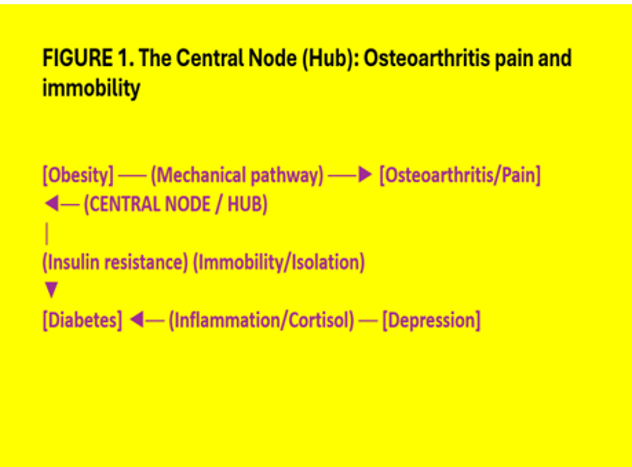
Figure 1: The Central Node (Hub): Osteoarthritis pain and immobility
By intervening with mathematical precision at the network's anchor points, the patient's geometric evolution (at 12 months) is as follows: Ellen drastically reduces her knee pain thanks to physical therapy (the hub weakens). She achieves a 12% weight loss with the change in metabolic drug. Weighing less and experiencing less pain, she resumes her daily walks with her neighbors; this breaks the isolation caused by her depression, allowing her to halve her antidepressant dosage. Her diabetes is now under strict control without the need for additional medication. The geometric network of illnesses, which previously expanded aggressively and chaotically, has contracted and stabilized, restoring homeostasis to Ellen's body.
Discussion
What is the "geometry" of the evolutionary process of multimorbidity?
The "geometry" of the evolutionary process of multimorbidity is a scientific metaphor used to describe how chronic diseases are structured, connected, and spread in the body and over time. Instead of a straight line, multimorbidity behaves like a multidimensional and dynamic network (10-13).
At a clinical and methodological level, this geometry is composed of four fundamental dimensions:
1. The Network Approach (Linear Geometry vs. Connected Networks). Traditional medicine understood health linearly: Cause → Disease. Multimorbidity breaks this line and adopts the geometry of a graph or network (Network Medicine) (14): Nodes: Represent the different diseases (e.g., diabetes, depression, osteoarthritis); Edges (Connections): Represent the strength of the relationship between them. If two diseases share genetic, inflammatory, or lifestyle causes, the line connecting them is thicker and shorter, attracting them to each other.
2. Clusters (Proximity Geometry). Diseases do not accumulate randomly; they group together in three-dimensional geometric shapes called clusters based on pathological affinity (15-19). The three most common axes or families discovered by mathematical epidemiology are: the Cardiopathometabolic Axis (a closed triangle between obesity, type 2 diabetes, and hypertension, expanding its vertices toward renal failure or myocardial infarction), the Neuropsychiatric/Mental Axis (close connections between depression, anxiety, and chronic pain), and the Immune-Inflammatory/Senescent Axis (clusters linking chronic obstructive pulmonary disease (COPD), bone fragility, and cognitive decline).
3. Temporal Trajectories (Vector Geometry). Multimorbidity has a direction and a speed (vectors). It is not a snapshot, but a film. Time geometry studies "disease trajectories." An initial pathology acts as the point of origin. The appearance of this first disease alters the patient's biological map, opening "preferential pathways" toward future diagnoses. For example, the most common geometric time trajectory begins with obesity, travels vectorially toward hypertension in 5 years, and branches off toward heart failure in the following 10 years.
4. Topology of Complexity (Multidimensional Space). To study a patient with 5 or 6 simultaneous diseases, current medical science uses topological mathematics. An n-dimensional space is created where each disease is a dimension. The patient's health status is a point that moves along this map. When the point falls on an "attractor" (a state of severe imbalance, such as a polypharmacy crisis or systemic decompensation), the system collapses. The goal of modern geometric medicine is to predict the position of that point to prevent it from falling into the attractor (20-22).
The design of disease network maps combines graph theory, bioinformatics, and big data analysis. This process translates the clinical reality of millions of medical records into an interconnected three-dimensional geometric plane (23-26).
What specific clinical strategies do GPs use to prioritize which disease to treat first, based on the concept of the "geometry" of multimorbidity evolution?
For a GP, applying the concept of the "geometry" of the multimorbidity evolutionary process means shifting from viewing diseases as a vertical list of diagnoses to viewing them in a three-dimensional space. The physician analyzes the patient's body as a system of nodes (diseases), edges (pathological connections), clusters, and vectors (temporal trajectories).
Under this mathematical and network approach, the GP uses four very specific prioritization strategies:
1. Attacking the "Central Node" or Hub of the Network: In network theory, a Hub is a highly connected node that supports all the others. If the Hub is destabilized, the entire network collapses; but if the Hub is controlled, multiple diseases are alleviated simultaneously. The physician prioritizes treating the pathology that acts as the patient's center of gravity.
2. Cutting Edges (Blocking Biochemical Connections): If two diseases are connected by an edge (for example, diabetes and depression share the systemic inflammation pathway), the physician prioritizes drugs or interventions that break that specific link.
3. Deflecting the Vectorial Trajectory (Geometric Anticipation): Diseases progress along predictable time vectors (trajectories). The physician calculates where the patient's vector is headed in the next 3 to 5 years and prioritizes actions to deflect that trajectory before it affects a new organ.
4. Containing the Frailty Attractor (Topological Stabilization): In the geometry of complex systems, an "attractor" is a zone of collapse. When a patient accumulates too many intersecting geometric lines, they enter a space of total instability. The physician prioritizes reducing complexity (by removing drugs or simplifying treatment regimens) to move the patient away from that functional black hole.
In short, sometimes in medicine we should learn from the work of geometers: they explore space, dimensions, and abstract forms. They study the properties, shapes and relationships of figures in space. They don't limit themselves to measuring land, but rather seek to understand the structure of the universe through pure logic. They break the classical postulate that parallel lines never intersect; they describe curved spaces.
References
- Carlson DM, Yarns BC. (2023). Managing medical and psychiatric multimorbidity in older patients. Ther Adv Psychopharmacol. 13.
View at Publisher | View at Google Scholar - Permanyer I, Gumà J, Trias-Llimós S, Solé-Auró A. (2026). Multimorbidity trends in Catalonia, 2010–21: a population-based cohort study. Int J Epidemiol. 55(1): dyaf218.
View at Publisher | View at Google Scholar - Al Izzati R, Pakpahan E. (2026). Longitudinal pattern of multimorbidity in older adult population: latent transition analysis in 34 countries. Am J Epidemiol 195(3): 653–663.
View at Publisher | View at Google Scholar - Turabian JL. (2017). About the Accumulation of Diseases in Certain People. J Gen Pract (Los Angel). 5: e120.
View at Publisher | View at Google Scholar - Ioakeim-Skoufa I, Vicente-Romero J, González-Rubio F, et al. (2026). Early dynamics of multimorbidity in 17.4 million people in Spain: onset patterns and prognostic value. Eur J Public Health. 36(3): ckag067.
View at Publisher | View at Google Scholar - Cuschieri S, Stranges S, Makovski TT. (2025). The different definitions of multimorbidity and their implications for research, surveillance, and policy. Eur J Public Health. 35(2): 197–198.
View at Publisher | View at Google Scholar - Turabian JL. (2020). The Character and Destination of Multimorbidity: Reflections for Classification. Archives of Community and Family Medicine. 3(2): 75-79.
View at Publisher | View at Google Scholar - Turabian JL. (2020). A Theory of Multimorbidity. Int Res Med Health Sci. (3-6): 9-16.
View at Publisher | View at Google Scholar - Turabian JL. (2020). Theory of the evolution of multimorbidity: it is created, in a small part but significant, by the medical intervention itself. COJ Reviews & Research. 2(3).
View at Publisher | View at Google Scholar - Capobianco E, Lio' P. (2013). Comorbidity: a multidimensional approach. Trends Mol Med. 19(9):515-21.
View at Publisher | View at Google Scholar - Sturmberg JP, Bennett JM, Martin CM, Picard M. (2017). 'Multimorbidity' as the manifestation of network disturbances. J Eval Clin Pract. 23(1):199-208.
View at Publisher | View at Google Scholar - Gilcrease W, Manfredi L, Sciascia S, Ricceri F. (2025). From Multimorbidity to Network Medicine in Patients with Rheumatic Diseases. Rheumatol Ther. 12(1):1-24.
View at Publisher | View at Google Scholar - Yu J, Li Y, Zheng Z, Jia H, Cao P, Qiangba Y, Yu X. (2021). Analysis of multimorbidity networks associated with different factors in Northeast China: a cross-sectional analysis. BMJ Open. 11(11):e051050.
View at Publisher | View at Google Scholar - Barabási AL, Gulbahce N, Loscalzo J. (2011).Network medicine: a network-based approach to human disease. Nat Rev Genet. 12(1):56-68.
View at Publisher | View at Google Scholar - Steell L, Krauth SJ, Ahmed S, et al. (2025). Multimorbidity clusters and their associations with health-related quality of life in two UK cohorts. BMC Med. 23(1):1.
View at Publisher | View at Google Scholar - Mikula-Noble N, Cormie V, McCowan RE, McCowan C. (2025). Identifying clusters of multimorbid disease and differences by age, sex, and socioeconomic status: A systematic review. PLoS One. 20(8):e0329794.
View at Publisher | View at Google Scholar - Bisquera A, Gulliford M, Dodhia H, et al. (2021). Identifying longitudinal clusters of multimorbidity in an urban setting: A population-based cross-sectional study. Lancet Reg Health Eur. 3:100047.
View at Publisher | View at Google Scholar - Turabian JL, Baltuille Aller C, Rodríguez Alcalá J, Velasco Llaves B, García Alvarez C, et al. (1997). [Community syndromes as a method of patient classification in Family Medicine]. MEDIFAM. 7:154-159.
View at Publisher | View at Google Scholar - Turabian JL, Perez Franco B. (2001). [Community Activities in Family Medicine and Primary Care]. Madrid: Díaz de Santos.
View at Publisher | View at Google Scholar - Prados-Torres A, Calderón-Larrañaga A, Hancco-Saavedra J, Poblador-Plou B, van den Akker M. (2014). Multimorbidity patterns: a systematic review. J Clin Epidemiol. 67(3):254-66.
View at Publisher | View at Google Scholar - Vinograd A, Nair A, Kim JH, Linderman SW, Anderson DJ. (2024). Causal evidence of a line attractor encoding an affective state. Nature. 634(8035):910-918.
View at Publisher | View at Google Scholar - Taherian Fard A, Ragan MA. (2017).Modeling the Attractor Landscape of Disease Progression: a Network-Based Approach. Front Genet. 8:48.
View at Publisher | View at Google Scholar - Ranea JAG, Perkins J, Chagoyen M, Díaz-Santiago E, Pazos F. (2022). Network-Based Methods for Approaching Human Pathologies from a Phenotypic Point of View. Genes (Basel). 13(6):1081.
View at Publisher | View at Google Scholar - Kim Y, Park JH, Cho YR. (2022). Network-Based Approaches for Disease-Gene Association Prediction Using Protein-Protein Interaction Networks. Int J Mol Sci. 23(13):7411.
View at Publisher | View at Google Scholar - Gil Hoed A. (2025). [Network medicine strategies for disease module characterization]. Trabajo Fin de Grado / Proyecto Fin de Carrera, E.T.S. de Ingeniería Agronómica, Alimentaria y de Biosistemas (UPM). Madrid.
View at Publisher | View at Google Scholar - Herrera JL, Gonzalez-Parra G. (2012). [Modeling contagious diseases using a dynamic social network class]. Rev. Fac. Ing. UCV. 27(2): 15-20.
View at Publisher | View at Google Scholar