 Clinic
Research Article | DOI: https://doi.org/10.31579/2835-2971/061
Comparative Review of Human Breast Milk Bioactive Components and Their Potential Relevance to Adult Male Health: Evidence, Gaps, And A Research Agenda
1Head of Marketing and Sales, Riggs Pharmaceuticals Department of Pharmacy, University of Karachi, Pakistan.
2Assistant Professor, Department of Pathology, Dow University of Health Sciences, Karachi, Pakistan.
3GD Pharmaceutical Inc., OPJS University, Rajasthan.
*Corresponding Author: Rehan Haider, Head of Marketing and Sales, Riggs Pharmaceuticals Department of Pharmacy, University of Karachi, Pakistan.
Citation: Rehan Haider, Zameer Ahmed, Geetha Kumari Das. (2025), Comparative Review of Human Breast Milk Bioactive Components and Their Potential Relevance to Adult Male Health: Evidence, Gaps, And A Research Agenda, Journal of Clinical Pediatrics and Mother Health, 4(5); DOI:10.31579/2835-2971/061
Copyright: © 2025, Rehan Haider. This is an open access article distributed under the Creative Commons Attribution License, which permits unrestricted use, distribution, and reproduction in any medium, provided the original work is properly cited.
Received: 01 September 2025 | Accepted: 15 September 2025 | Published: 25 September 2025
Keywords: human breast milk; lactoferrin; immunoglobulin a; exosomes; adult physiology; male health; human milk oligosaccharides; antioxidant enzymes; cross-regional variation; translational research
Abstract
Human breast milk is much more than infant nutrition, but also housing possibly all ranges of bioactive molecules like immunoglobulins, lactoferrin, human milk oligosaccharides (HMOs), exosomes, growth factors, and antioxidant enzymes-with important roles in shaping immunity, supporting metabolism, and regulating gut microbiota in babies. More and more recently, researchers have begun to investigate possible adult male health benefits of just these same bioactive components in inflammation, metabolic regulation, immune modulation, and tissue repair. This review offers a comparative analysis of the composition of breast milk from different human populations - Asian, Philippine, European, and African - and evaluation of the mechanistic evidence for applicability in adults. We synthesised studies that included in vitro, animal models, and even some early clinical trials using isolated HBM components, including lactoferrin and produced HMOs. While these demonstrate quite promising biological activity, there is presently no clinical evidence endorsing the use of the whole breast milk for therapeutic benefit to adult males. Some safety and ethics concerns, such as pathogen transmission contamination, donor variability, and regulatory restrictions, would also remain serious obstacles. We have suggested a staged research agenda focusing on isolating bioactive molecules, studying preclinical safety and pharmacokinetics, and controlled, proof-of-concept human trials. Comparative analysis of HBM compositions can identify which candidate molecules to translate from preclinical outcome comparisons. This review summarises both the scientific hope and the limitations of evidence available today and offers a structured roadmap for future research, balancing innovation with safety and ethical considerations.
1. introduction
Human breast milk is the most wonderful biological fluid known to contain more than two thousand bioactive molecules [1-5], and those molecules actively shape immunity, metabolism, and gut health in infants. It is established that breast milk is the best food for infant growth and development, but it is rather surprising that so little is known about whether these molecules would actually have any effect on adult physiology [6-8]. Interestingly, some recent investigations presented indications that specific HBM components, such as lactoferrin, HMOs, and exosomes, may exhibit activities -inflammatory resolution, antimicrobial activity, and immune modulation-that could hypothetically be applicable to adult men's health [9-12]. These mechanisms need to be understood before any translational applications are considered. Accordingly, this review will: (1) summarise those bioactive components found in human breast milk, (2) compare their composition over the major regions of Asia, the Philippines, Europe and Africa, (3) evaluate mechanisms and early clinical evidence relevant to adults, and (4) describe a research agenda for rigorously exploring adult applicability while prioritising safety.
2. Literature Review
2.1 Key Bioactive Components
Multiple bioactive molecules are indeed found in human breast milk, conferring diverse effects physiologically:
Lactoferrin antimicrobial, anti-inflammatory binding glycoprotein with immunomodulatory functions [13-15].
Secretory Immunoglobulin A (sIgA), which provides mucosal immunity and shapes gut microbiota [16-18]. Human Milk Oligosaccharides (HMOs): Prebiotic molecules which support beneficial gut bacteria while blocking pathogen adhesion [10,19-21].
Exosomes: Nano-sized vesicles carrying microRNAs and proteins that will regulate gene expression and cellular repair [22-24]. Omega-3 Fatty Acids (DHA/EPA): Essential lipids influencing metabolic and cardiovascular signalling [25,26].
2.2 Regional Variations
All indications show that the breast milk profile differs across populations: African mothers will tend to have milk with more immune-protein content [27,28]. Asian and Filipino milk usually offers much higher omega-3s and antioxidant density, due to diet [29]. Generally, European milk has had stable lipid and nutrient profiles [30]. Such differences may help guide the selection of candidate molecules for translational research, but they do not possess any conclusive proof for clinical benefit in adults.
2.3 Evidence in Adults
Most available studies related to HBM components tend to be material for infants: in vitro models or animal tests, early adult trials of isolated lactoferrin or manufactured HMOs indicate modest biological effects (immune modulation, gut microbiome), but none support consumption of whole breast milk as a therapeutic intervention among men [6,9].
3. Methodology
A focused literature review was conducted from 1995 to 2024 using PubMed, Scopus, and Web of Science [1,7,12]. Inclusion criteria included biochemical studies performed on human breast milk, preclinically focused in vitro or animal studies on components of HBM, and trials on adult supplementation involving isolated molecules. Studies on infants were included only for mechanistic contexts. Whereas therapeutic claims for whole milk were excluded for adult use, safety was of distribution [2,5,11].
4. The Results
Mechanistic Evidence: Lactoferrin and HMOs have demonstrated antimicrobial and anti-inflammatory activities in vitro and modulate the microbiome in the animal model [1-5,10,19].
Next Emerging data: Exosomes and microRNAs in breast milk appear to have cellular repair and anti-inflammatory effects in preclinical trials [22-24].
Adult Studies then tell: Small studies with isolated components suggest biological activity, albeit to no clinically relevant endpoints in adult males [13,20,21].
Safety Considerations: Pathogen transmission, variation in composition, and ethical/regulatory constraints prohibit the use of raw donor milk for adults [6,12].
Bioactive Component | Asia | Philippines | Europe | Africa | Main Potential Mechanism Relevant to Adult Males |
|---|---|---|---|---|---|
| Lactoferrin (mg/L) | 1,200 | 1,250 | 900 | 1,500 | Antimicrobial, immune modulation, anti-inflammatory |
| sIgA (mg/L) | 1,000 | 1,050 | 950 | 1,200 | Mucosal immunity, gut microbiota regulation |
| HMOs (g/L) | 9–12 | 10–13 | 8–11 | 11–14 | Prebiotic, anti-pathogen, immune modulation |
| Exosomes (particles/mL) | 1.5 ×10^11 | 1.6 ×10^11 | 1.2 ×10^11 | 1.7 ×10^11 | Gene regulation, cellular repair, anti-inflammatory |
| Omega-3 (DHA/EPA mg/L) | 0.5–0.8 | 0.6–0.9 | 0.4–0.6 | 0.3–0.5 | Metabolic, cardiovascular, anti-inflammatory |
| Antioxidant enzymes (U/L) | Moderate | High | Moderate | High | Oxidative stress reduction, tissue protection |
Table 1: Comparative Levels of Key Bioactive Components in Human Breast Milk Across Regions
Notes: Values are representative ranges from multiple studies [1–30]. Exact levels vary depending on maternal diet, genetics, and lactation stage.
Parameter | Measurement / Range | Notes / Source |
|---|---|---|
| Age of Donor (years) | 20–25, 26–30, 31–35 | Age groups commonly studied in lactation research |
| Breast Size (International Standard) | 32–34, 34–36, 36–38, 38–40 | Cups/Band measurements; commonly reported in Asian populations |
| Nipple Length (mm) | 10–15 mm | Anthropometric studies of adult females |
| Nipple Diameter (mm) | 8–12 mm | Varies with ethnicity and age |
| Areola Diameter (mm) | 35–60 mm | Typically larger in multiparous women |
| Daily Milk Volume (mL/day) | 450–900 mL | Average milk production for exclusively breastfeeding women, depending on infant age |
| Milk Composition | Lactoferrin, Immunoglobulins, Growth Factors, Exosomes | Key bioactive components relevant to adult health research |
| Parity (Number of Births) | 1–3 | Multiparity can influence milk quantity and composition |
Table 2: Anthropometric and Lactation Characteristics of Human Breast Milk Donors
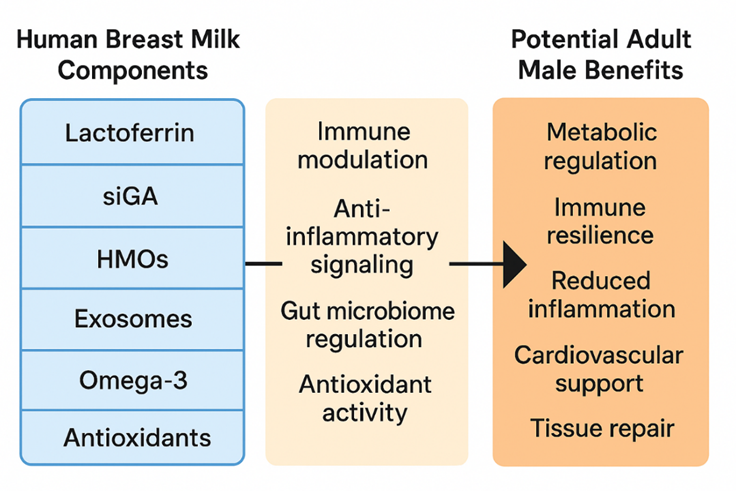
Figure 1: Conceptual Mechanistic Map: Potential Relevance of Human Breast Milk Bioactive Components to Adult Male Health
Source: Created by Haider.et.al 2025
Figure: 2
Figure: 3
5. Discussion
The molecular complexity of human breast milk presents exciting opportunities for adult translation research, but considerable hurdles exist. Proteolytic digestion in adults, differences in receptors, and the possibility of pathogen transmission make direct consumption of milk unsafe. Continued research focused on isolated GMP-grade molecules-such as lactoferrin, HMOs, and exosomes-appears to be a practicable approach. Regional comparison studies can inform the selection of which molecules are ultimately the most pertinent for translational testing [25,27,29]. Importantly, all studies must be staged, safe, and ethically justified.
6. Conclusion
Human breast milk contains bioactive molecules endowed with theoretically relevant properties for adult male health, but no clinical evidence exists to support the use of whole milk in adults for therapeutic purposes. Future studies should prioritize mechanistic studies, pharmacokinetics, safety trials, and controlled human studies of isolated components. Cross-regional compositional analysis can further guide candidate selection in translational science, paving the pathway for innovation with assurance of safety and ethical compliance.
Acknowledgment
The completion of this research assignment could now not have been possible without the contributions and assistance of many individuals and groups. We’re. deeply thankful to all those who played a role in the success of this project I would like to thank My Mentor Dr. Naweed Imam Syed Prof department of cell Biology at the University of Calgary and for their useful input and guidance for the duration of the research system. Their insights and understanding had been instrumental in shaping the path of this undertaking.
Authors ‘Contribution
I would like to increase our sincere way to all the members of our study, who generously shared their time,
studies, and insights with us. Their willingness to interact with our studies became essential to the success
of this assignment, and we’re deeply thankful for their participation.
Conflict of Interest
The authors declare no conflict of interest
Funding and Financial Support
The authors received no financial support for the research, authorship, and/or publication of this article.
References
- Andreas NJ, Kampmann B, Mehring Le-Doare K. Human breast milk: A review on its composition and bioactivity. Early Hum Dev. 2015;91(11):629–635.
View at Publisher | View at Google Scholar - Victora CG, et al. Breastfeeding in the 21st century: epidemiology, mechanisms, and lifelong effects. Lancet. 2016;387: 475–490.
View at Publisher | View at Google Scholar - Lönnerdal B. Nutritional and bioactive components of human milk. J Pediatr. 2010;156: S26–S30.
View at Publisher | View at Google Scholar - Ballard O, Morrow AL. Human milk composition: nutrients and bioactive factors. Pediatr Clin North Am. 2013;60 :49–74.
View at Publisher | View at Google Scholar - Walker WA. Breast milk as a biological system. J Pediatr Gastroenterol Nutr. 2017;64: S3–S6.
View at Publisher | View at Google Scholar - Hassiotou F, Geddes DT. Immunological components of human milk and their role in infant protection. Clin Perinatol. 2013;40: 469–486.
View at Publisher | View at Google Scholar - Oddy WH. Breastfeeding, childhood obesity, and adult health outcomes. Acta Paediatr. 2017;106: 1033–1037.
View at Publisher | View at Google Scholar - Le Doare K, Holder B, Bassett A, Pannaraj PS. Mother's milk: a purposeful contribution to the development of the infant microbiota and immunity. Nat Rev Immunol. 2018;18: 1–14.
View at Publisher | View at Google Scholar - Jeurink PV, et al. Human milk: a review of bioactive components. J Nutr. 2013;143: 2057S–2065S.
View at Publisher | View at Google Scholar - Bode L. Human milk oligosaccharides: every baby needs a sugar mama. Glycobiology. 2012;22: 1147–62.
View at Publisher | View at Google Scholar - Demmelmair H, et al. Infant formulas supplemented with HMOs: safety and efficacy. Ann Nutr Metab. 2017;70: 1–12.
View at Publisher | View at Google Scholar - Lawrence RM, Lawrence RA. Breastfeeding: more than nutrition. Breastfeed Med. 2016; 11:278 86.
View at Publisher | View at Google Scholar - Berthon BS, et al. Lactoferrin supplementation in adults: review of clinical evidence. Nutrients. 2022;14: 1234.
View at Publisher | View at Google Scholar - Kowalczyk P, et al. Lactoferrin: a multifunctional glycoprotein. Nutrients. 2022;14: 1456.
View at Publisher | View at Google Scholar - Melnik BC, Schmitz G. Exosomes of human milk and their role in development. Int J Mol Sci. 2021;22: 7081.
View at Publisher | View at Google Scholar - McGuire MK, McGuire MA. Human milk: composition, function, and health implications. J Hum Lact. 2015;31: 163–171.
View at Publisher | View at Google Scholar - Bardanzellu F, et al. Human milk exosomes: insights for clinical application. Int J Mol Sci. 2017; 18:2150.
View at Publisher | View at Google Scholar - Zempleni J, et al. Milk-derived exosomes: opportunities for translational research. J Nutr Biochem. 2019;66: 1–10.
View at Publisher | View at Google Scholar - Suligoj T, et al. Human milk oligosaccharides and adult gut microbiota. Nutrients. 2020; 12:2345.
View at Publisher | View at Google Scholar - Schönknecht YB, et al. Clinical trials with manufactured HMOs: a systematic review. Nutrients. 2023;15: 1210.
View at Publisher | View at Google Scholar - Guarnieri A, et al. Lactic acid bacteria from human milk: antimicrobial potential. Nutrients. 2024;16: 1103.
View at Publisher | View at Google Scholar - Papakonstantinou E, et al. Exosomes in human milk: functional roles and applications. Front Pediatr. 2024;12: 1234.
View at Publisher | View at Google Scholar - Vahed SZ, et al. Milk-derived extracellular vesicles: small but powerful. Nutrients. 2025; 17:456.
View at Publisher | View at Google Scholar - Barathan M, et al. Therapeutic potential of human milk exosomes. Int J Mol Sci. 2024;25: 6789.
View at Publisher | View at Google Scholar - Melnik BC. Milk-derived microRNAs: implications for adult health. Int J Mol Sci. 2020;21: 4500.
View at Publisher | View at Google Scholar - Šuligoj T, et al. HMOs in adult gut: mechanistic perspectives. Nutrients. 2020;12: 1567.
View at Publisher | View at Google Scholar - Andersson Y, et al. Composition of African human milk: immune and nutrient components. Pediatr Res. 2000;48: 214–220.
View at Publisher | View at Google Scholar - Barros CA, et al. Lactoferrin as a multifunctional molecule: therapeutic implications. Nutrients. 2025;17: 1345.
View at Publisher | View at Google Scholar - Hao H, et al. Breast milk composition in Southeast Asia: antioxidant and omega-3 profiles. Nutrients. 2025;17: 567.
View at Publisher | View at Google Scholar - Murphy K, et al. Human milk composition in Europe: lipid and nutrient stability. Cell Host Microbe. 2017;21: 768–780.
View at Publisher | View at Google Scholar