 Clinic
Review | DOI: https://doi.org/10.31579/2834-8087/040
Albucasis Role in the Development of Perineal Cystolithotomy: A Historical systemic Review
- Aeliya Rukhsar *
- Saiyad Shah Alam1 Jamal
- Ghazala Akhtar Javed
- Director National Institute of Unani Medicine, Kottigepalya, Magadi Main Rd,
- Bengaluru, Karnataka, India, 0000-0003-1841-8264
- Research Officer Unani (S-IV), Central Council for Research in Unani Medicine, D-block
- Janakpuri, New Delhi, India, https://orcid.org/0000-0001-8400-47782 Assistant Director (Unani) & Technical Head, Central Council for Research in Unani
- Medicine, D-block Janakpuri, New Delhi, India, https://orcid.org/0000-0002-4298-0401
*Corresponding Author: Aeliya Rukhsar Email, Candidate of biological science, Assistant professor of pathophysiology department named D. A. Malakhov, Grodno State Medical University; Grodno State Medical University, 80 Gorky St,230009, Grodno, Belarus
Citation: Gayatri R. Ganapathiraju, Neelesh K. Maurya, (2025), Albucasis Role in the Development of Perineal Cystolithotomy: A Historical systemic Review, Archives of Clinical Investigation, 4(3); DOI:10.31579/2834-8087/040
Copyright: © 2025, Neelesh Kumar Maurya. This is an open access article distributed under the Creative Commons Attribution License, which permits unrestricted use, distribution, and reproduction the original work is in any medium, provided properly cited.
Received: 05 May 2025 | Accepted: 15 May 2025 | Published: 26 May 2025
Keywords: breakfast skipping; adolescence; cognitive development; academic performance; nutrition; obesity prevention; meal patterns
Abstract
Abstract
Purpose
We analysed the urological sections of Al-Tasrif by Abacaxis, with particular attention to the management of bladder stones, the surgical instruments described for their extraction, and the operative techniques outlined.
Materials and Methods
Al-Tasrif, a surgical text authored by Al-Zahrani (who lived in Al-Andalus between 930 and 1013 CE), was critically evaluated with regard to its descriptions of urinary bladder stones and the surgical instruments used for their management.
Results
The textbooks provide detailed information on the surgical management of the urinary bladder stones by perineal cystolithotomy. Additionally, they include descriptions of the surgical instruments used in the removal of these stones.
Conclusion
This comprehensive historical analysis highlights the crucial part Abacaxis (Al-Zahrani) played in the inception and early stages of perineal cystolithotomy. As one of the foremost surgical innovators of the Islamic Golden Age, Abacaxis provided the first detailed descriptions of bladder stone removal via the Perineal route, laying the foundation for centuries of urological practice.
1.Introduction
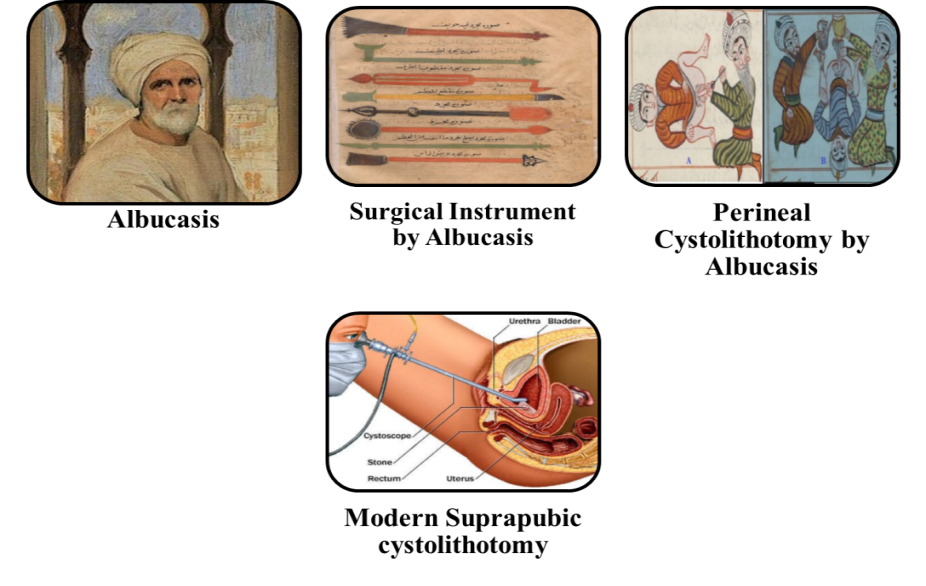
Khalef ibn Abbas Al-Zahrᾶwĩ.2At that time, there was a huge University in Cordova. Thus, they are known in the West as Zahravius or Albucasis.3 He worked as the court physician to Caliph Al-Hakam II during the period considered the “Golden Age” of Arab Spain. After a long and distinguished medical career, he died in 1036 AD at the age of 77. 4 He was an ascetic man who devoted much of his time to working among the poor. To perform the operation, he always shaved the area first. 5 Bleeding, surgical procedures, Cupping, and cauterization constituted the major form of surgical practice at that time.6 There was approximately 50 hospitals in the Cordova.7 The name Al-Tasrif is associated with a monumental medical vade mecum, composed of thirty volumes covering various branches of medicine, including anatomy, pharmacology, and therapeutics. The thirtieth and final volume is the most renowned, as it deals exclusively with surgery and surgical instruments. This section, often referred to as On Surgery and Instruments, includes detailed descriptions of operative techniques and over 200 surgical tools, many of which were illustrated for the first time in medical history.8 Al-Tasrif was the first illustrated and systematic text on surgical subjects. While much of its content was adapted and modified earlier contributions particularly those of Paul of Aegina and other Greco-Roman physicians. Albucasis’s meticulous descriptions and structured guidance reflected a cautious, ethical, and thoughtful approach to surgical practice.9 In general, 28th treaties of Al-tasrif strictly related to pharmacy. 15 The 28th treatise was significantly pleasant in Europe under the Latin title Liber servitor, that deals mainly with Pharmaceutical techniques for manufacturing tables, lozenges troches, syrups, etc., are also discussed in it. 16 Likewise, and the second section and 29th treatise is also of great historical significance. It is on synonyms of drugs in several language, namely Arabic, Greek, Syriac, Latin and Spanish, arranged in alphabetical order; substitutes of drugs in case of non-availability of the unique ones and weight and measures as used in various localities. Finally, the 30th treatise of the book, comprising three sections (abwab) is on surgery and its application. The first section, containing 56 chapters, deals in detail with different aspects of cauterization for discussing ancient texts regarding cautery of fistula in the inner corner of the eye and also cautery of the stomach and the ‘cold liver’ and the tools and techniques used in it. The second section comprising 93 chapters deals with matters relating to incision, perforation, wounds and their healing, bloodletting, wet and dry cupping; while the third section is devoted to the discussion of fractures and dislocation of joint, including fracture of the pelvis, bone-setting, bruises, joint.10The total Descriptions of Perineal cystolithotomy can be found in ancient Indian, Chinese, Babylonian, and Greek medical texts. An Egyptian excavation revealed the oldest bladder stone, which dates to around 4800 BCE, in the grave of a 16-year-old boy. In 1901, the English archaeologist E. Smith discovered a bladder stone in a mummy estimated to be 4500–5000 years old from El Amrah, Egypt. This finding is significant because it represents one of the earliest known cases of urolithiasis (bladder stone disease) in human history.13 This remarkable find provides early evidence of urinary tract conditions affecting humans in ancient times. The Hippocratic Oath of “Neither will I cut them that have the stone,” without due emphasis on its subsequent qualification, “but will leave this operation to those who are accustomed to perform it.”1, 20 Bladder and urethral stones, affecting both children and adults, have long represented a significant urological concern in the Arab world. Their treatment was thoroughly described by early physicians such as Albucasis, Rhazes (AD 850–923), Hali Abbas, and Avicenna (AD 980–1037). But Albucasis (Al-Zahrawi), the renowned 10th-century Muslim surgeon, invented the perineal cystolithotomy, a surgical technique for removing bladder stones through an incision in the perineal region. Albucasis was born in Zahra, near to Cordova, around 936 AD.1 His real name was Abu’I-Qasim number of pages in this book is 1000 and consisting of 30 volumes.10 It contained more than 200 illustrations and descriptions of surgical instruments, most of which were created by Al-Zahrawi himself. 11 He was the first medical writer to illustrate surgical tools. 12 Abul-Qasim Khalaf Ibn Abbas Al-Zahrawi (Albucasis) discussed the surgical extraction of bladder stones in the renowned Thirtieth Treatise of his medical encyclopedia, Al-Tasrif. Sushruta, an ancient Indian surgeon who lived around 600 BCE, is regarded as one of the earliest pioneers of surgery. He authored the Sushruta Samhita, a foundational text in Ayurvedic medicine. This comprehensive work describes over 300 surgical procedures and details the use of more than 120 surgical instruments. Notably, Sushruta provides a thorough account of perineal lithotomy a procedure to remove bladder stones through an incision in the perineum. 14 Albucasis (AD 936-1013) described crushing of the stones if the stone was large or irregular, he advocated the use of the michab, an instrument which was passed up the urethra and drilled the stone into fragments which were subsequently washed out by the passage of urine.15 The aim of this study is to examine historical sources and surgical practices related to perineal cystolithotomy, with a focus on evaluating and highlighting the significant contributions of Albucasis (Abu al-Qasim al-Zahrawi). In particular, this study explores his innovations in surgical technique, instrumentation, and ethical practice, and how his work profoundly influenced the development and evolution of urological surgery. 15
List of abbreviations and acronyms
Acronym | Description |
AD | Anno Domini |
BC | Before Christ |
Abacaxis | Al-Zahrani |
E. Smith | Edwin Smith |
Rhazes | Al-Razi |
PS | Perineal Cystolithotomy |
AC | Anal Canal |
Materials and Methods
This systematic review was undertaken according to the Preferred Reporting Items for Systematic Reviews (PRISMA) standards
Materials and Methods
This systematic review was undertaken according to the Preferred Reporting Items for Systematic Reviews (PRISMA) standards
Search Strategy
A systematic literature search, between 1959 and 2010, was conducted using the following databases: PubMed, MEDLINE, EMBASE, and CCRUM Library. The search strategy used both free-text terms and Medical Subject Headings (MeSH) to identify articles for the review. That is (MH "Albucasis") OR (MH "Al-Tasrif") OR (MH "Urolithiasis") OR (MH " Perineal Cystolithotomy") OR (MH "michab") AND (MH "Rhazes") OR (MH "PRISMA") AND (MH "Jarahat") OR (MH "Al-Zahrawi Instruments") OR (MH "Al-Zahrawi Surgical Procedure") OR "Kidney Stone" OR (MH "Ancient Cystolithotomy") OR (MH "Historical background Albucasis"). In addition, the reference lists of the retrieved studies and review articles were screened to identify any additional relevant studies.
Search Strategy
A systematic literature search, between 1959 and 2010, was conducted using the following databases: PubMed, MEDLINE, EMBASE, and CCRUM Library. The search strategy used both free-text terms and Medical Subject Headings (MeSH) to identify articles for the review. That is (MH "Albucasis") OR (MH "Al-Tasrif") OR (MH "Urolithiasis") OR (MH " Perineal Cystolithotomy") OR (MH "michab") AND (MH "Rhazes") OR (MH "PRISMA") AND (MH "Jarahat") OR (MH "Al-Zahrawi Instruments") OR (MH "Al-Zahrawi Surgical Procedure") OR "Kidney Stone" OR (MH "Ancient Cystolithotomy") OR (MH "Historical background Albucasis"). In addition, the reference lists of the retrieved studies and review articles were screened to identify any additional relevant studies.
Study Selection
The search was conducted by two investigators, who independently screened all titles and abstracts for eligibility according to the predefined inclusion and exclusion criteria. Discrepancies were resolved through discussion with the third investigator. Studies were included in the review according to the following inclusion criteria: 1) Studies Reported Perineal Cystolithotomy 2) Studies related to the historical Background of Albucasis 3) Review Article related to Al-Tasrif and 4) Studies published in English in a peer-reviewed journal. The exclusion criteria were as follows: 1) Protocol papers and conference abstracts 2) Study with other Albucasis surgical Procedures and 3) Studies not published in English.
Related research works
This section summarizes several related studies in preparation for comparisons with the current work and offers an overview of the current literature addressing Perineal Cystolithotomy from several perspectives. Elcioglu, et al.16 conducted a systematic review on Urinary Bladder Stone Extraction and Instruments Compared in Textbooks of Abu'I-Qasim Khalaf Ibn Abbas Al-Zahrawi (Albucasis) (930–1013) and Serefeddin Sabuncuoglu (1385–1470) to investigated urinary bladder stone, surgical tools, and procedures in urologic sections of textbooks of Abu'I-Qasim Khalaf Ibn Abbas Al-Zahrawi (Albucasis) and Serefeddin Sabuncuoglu. Their review supported the conclusion that Perineal cystolithotomy well explained in the Al-Tasrif. More recently, Rabie et al.17 Extraction of urinary bladder stone as described by Abu'I-Qasim Khalaf Ibn Abbas Al- Zahrawi (Albucasis) (325-404 H, 930-1013 AD) A translation of the original text and a commentary also described the detailed study of the technique of cystolithotomy as practiced by the Muslim surgeon Alzahrawi (Albucasis).
Related research works
This section summarizes several related studies in preparation for comparisons with the current work and offers an overview of the current literature addressing Perineal Cystolithotomy from several perspectives. Elcioglu, et al.16 conducted a systematic review on Urinary Bladder Stone Extraction and Instruments Compared in Textbooks of Abu'I-Qasim Khalaf Ibn Abbas Al-Zahrawi (Albucasis) (930–1013) and Serefeddin Sabuncuoglu (1385–1470) to investigated urinary bladder stone, surgical tools, and procedures in urologic sections of textbooks of Abu'I-Qasim Khalaf Ibn Abbas Al-Zahrawi (Albucasis) and Serefeddin Sabuncuoglu. Their review supported the conclusion that Perineal cystolithotomy well explained in the Al-Tasrif. More recently, Rabie et al.17 Extraction of urinary bladder stone as described by Abu'I-Qasim Khalaf Ibn Abbas Al- Zahrawi (Albucasis) (325-404 H, 930-1013 AD) A translation of the original text and a commentary also described the detailed study of the technique of cystolithotomy as practiced by the Muslim surgeon Alzahrawi (Albucasis).
Results
Alzahrawi’s description of the extraction of urinary bladder stones in Al-Tasrif
Chapter-60 on the Extraction of the Stone.
‘‘In the starting of the treatment of bladder stone, an enema is required for the patient to clean out his bowel “Because the stools may interfere with searching for and locating the stone.” Then the patient should be held by his legs and shaken downwards to bring the stone down to the bladder neck or, he could jump from a height many times. In order to tilt the bladder downward, “sit him erect facing you with his hands under his thighs”. Then examine anal canal for the search of the stone by palpating him externally. If the stone is palpated within the lumen, it should be immediately crushed. But if the stone cannot be palpated digitally reinsert finger, by lubricating with oil, into his anal canal and search out for the stone when it comes under your finger move it, little by little, to the bladder neck. Press upon it with your finger pushing it outwards to the place where you wish to make your incision. Request an assistant to squeeze the bladder with his hand. Another assistant should use their right hand to retract the testicles and their other hand to stretch the skin beneath the testicles away from the surgical site. Then, take the Al-Nashl scalpel and make an incision between the anus and the testicles, not on the midline but slightly toward the left buttock. The incision should be made directly over the stone while your finger in the anus presses it outward. The incision is made oblique, and it should be just enough to allow the exit of the stone, not larger, as your finger in the anus leads to its extrusion without difficulty. Some important points to be remember in the, management of stone. Symptoms include passing thin, watery urine containing sand-like particles, and the patient often rubs or plays with the penis due to discomfort.16
Advice from Alzahrawi’s if there is still a problem with the extraction
If you still cannot extract the stone, widen the incision slightly. If bleeding occurs, it should be controlled using sulfuric acid, as recommended in historical surgical practices. When multiple stones are present, first push the largest stone toward the bladder neck and incise over it, then extract the smaller ones. Avoid making an excessively large incision, as this may lead to stool incontinence. Instead, the stone should be carefully manipulated out, or the Al-Kalbatain instrument may be used to break it into pieces for removal
Explanation of bladder stone removal procedure
Bladder stone removal is one of the oldest surgical procedures in medical history. Traditionally performed through a perineal incision. Ancient Greek and Roman medicine did not practice preoperative bowel preparation with enemas. Mohamed Ibn Zakariya Razi (Rhazes) (841–926 AD) was the first to describe the use of enemas for bowel preparation before bladder stone surgery. In his book Alhawi Alkabeer (The Continens), “He stated that the stools in the rectum may render palpation for, and locating of, bladder stones difficult or impossible, ; it is essential that the patient be given an enema beforehand. When the bowels are emptied, locating the stone and abdominal palpation become significantly easier." The Iranian physician Al-Razi designed a strong metallic pincer called the Almajarrah to firmly grasp. A piece of the bladder stone that was intended to come out through a little cystotomy in the perineum. This instrument was then used to break the stone into smaller pieces until it was small enough to be removed.20 The choice of finger used for the per rectal examination is determined by the size of the anal orifice, which varies according to the patient’s age. The assistant’s hand applies downward pressure on the supra pubic area. Maintaining this pressure on the bladder helps prevent the stone from dislodging from the surgeon’s left index finger, which is already.22 Assigning this task to an assistant allows the surgeon’s right hand to remain free for performing the subsequent steps of the operation. While the surgeon’s left hand maintains per rectal fixation of the stone, an assistant is required to retract the testicles and tension the skin at the incision site. Most likely, Al-Razi (Rhazes) used Menges’s scalpel, which he referred to as Al-Imadein, providing a more precise description of its shape. The incision made by Al-Madeine was not perfectly circular, a design intended to facilitate deeper penetration. It is likely that Al-razi (Rhazes) employed a scalpel similar to that described by Meges, which is referred to as "Al-Imadein”. He provided a detailed description of its shape, and stated that "The incision is then made by “Al-Imadein, which is not quite circular, to facilitate deeper penetration. Al-Zahrawi pioneered the design of a lithotomy scalpel distinguished by two sharp cutting edges, an innovative instrument previously undocumented in surgical literature and meticulously rendered its illustration. This instrument, termed the Novacula, was later adopted by the Italian surgeon Marianus Sanctus in the sixteenth century and by the English surgeon Shelsden in the eighteenth century.¹⁷ Moreover, Al-Zahrawi is credited as the first surgeon to employ forceps specifically for the extraction of bladder calculi. Prior to his innovation, stones were removed using an instrument resembling a small spoon that encircled the stone and scooped it out. Al-Razi (Rhazes) employed this spoon-like instrument, which he called Almajarrah, meaning “the dragger” or “the scoop”. However, he also described that, when dragging a stone out, it may be necessary to use the Al-Kalbatain, an instrument similar to arrow extractor forceps. Nevertheless, Al-Zahrawi introduced a new instrument specifically designed for this purpose, offering a superior grip on the stone.¹⁸, ²¹
Perineal cystolithotomy by Celsus
Perineal lithotomy was thoroughly described by Celsus in the first century AD and was known for many years as the methods Caliana. This procedure proved most effective in children under the age of 14, as an enlarged prostate in adults made the operation considerably more difficult into the rectum to press the stone against the perineum. An incision was then made in front of the anus, extending into the region of the bladder trigone. The stone was extracted either manually or with the aid of a hook. This straightforward technique was referred to as the apparatus minor. Around 1520, a more radical operation was introduced in Italy and popularized by Marianus. Due to the numerous instruments involved, this new approach was called the apparatus major. 23. During the surgery, a child was held securely in the lap of a strong assistant, while adult patients were restrained in the lithotomy position by three or four attendants. The surgeon inserted one or two fingers
Surgical instruments used in perineal cystolithotomy by Adzharia
Al-Zahrani played a pivotal role in the evolution of urology, particularly in the surgical management of bladder stones, and is widely recognized by Spink and Lewis as the founder of lithotripsy and Kirkup 31, 32 He introduced innovative instruments such as forceps, the drill (mithqab), scalpel, and the metal probe (mirwed) that revolutionized bladder stone surgery by reducing procedural risks and enhancing patient safety and outcomes. Al-Zahrawi’s forceps were specifically designed to crush large bladder stones, functioning as a primitive lithotrite that facilitated their gradual removal. In the 18th century, Andreas A. Cruce introduced a significant modification by replacing manual handle compression with a screw mechanism, thereby enhancing both precision and operative control. In the 19th century, Heurtloup further refined Al-Zahrawi’s lithotrite by substituting the jointed, saw-toothed blades with separated parallel blades, thereby improving both the efficiency and safety of stone fragmentation. 33, 34 The drill, crafted from Damascene steel with a sharp triangular tip and a wooden handle, was used to perforate residual small stones that migrated toward the urethra and obstructed urinary flow. Al-Zahrawi manually rotated the drill to pierce the stone, thereby facilitating its extraction and subsequent bladder irrigation 35 Rigal de Gaillac, Fournier de Lempdes, and Franz von Gruithuisen utilized drills whose designs bore a striking resemblance to Al-Sahrawi’s original instrument. By the 19th century, however, Al-Zahrawi’s drill was eventually superseded by a rotating wheel mechanism introduced by Leroy d’Ettiole, which was later refined by Jean Civiale. 35, 36, 37 . Al-Zahrawi introduced the scalpel in lithotripsy to make an incision in the perineal region, between the anus and the testicles. This instrument differed from the scalpel described by Meges of Sidon in the first century, which featured two sharp cutting edges. In contrast, Al-Zahrawi’s design featured a broad, blunt upper edge that enabled the surgeon to apply controlled pressure, while the semicircular lower edge was sharpened for precise cutting. Meges of Sidon, one of the most prominent methodic surgeons of the late first century B.C.E. and the most important Roman surgeon before Galen, is credited with inventing a double-edged blade used to remove stones from the neck of the bladder. His lithotomy blade remained in use well into the middle Ages.
Discussion
Among the earliest recorded surgical interventions was the removal of bladder stones. The procedure involved a perineal incision extending to the bladder neck, followed by the extraction of the stone. This operative description invites comparison with techniques documented in ancient Indian civilization. Alzahrawi's modifications and innovations spread to Europe in the middle Ages and continued to be widely used until the early eighteenth century, when the current technique for removing bladder stones began to use the supra-pubic approach rather than the perineal one. 19, 20. There are three possible approaches to the bladder for the removal of a calculus making a perineal incision to reach the base of the bladder, performing a suprapubic cystotomy to open the bladder above the pubis, or crushing the stone using instruments introduced through the urethra.23, 24, 25 French barber-surgeon Pierre Franco (c. 1500–1565) made numerous significant contributions to the early field of surgery. One of the first people to effectively describe and conduct suprapubic lithotomy.26 By the beginning of the 18th century, James Douglas (1675–1742) was a Scottish anatomist best known for describing the Pelvic Peritoneal pouch, now called the Pouch of Douglas (recto-uterine pouch) Douglas specifically examined the peritoneal reflections and fascial planes, aiming to identify safe surgical approaches to the bladder, crucial for procedures like lithotomy.27, 28.Jean Cividale (1792–1876) first demonstrated a lithotrity instrument on January 13, 1824, which enabled the crushing and subsequent removal of bladder stones via the urethra.29
Conclusion
The importance of Abacaxis (Al-Zahrani) in the beginnings and early stages of perineal cystolithotomy is highlighted by this thorough historical review. As one of the foremost surgical innovators of the Islamic Golden Age, Abacaxis provided the first detailed descriptions of bladder stone removal via the perineal route, laying the foundation for centuries of urological practice. His emphasis on precision, specialized instruments, and patient selection reflects a remarkably advanced understanding of surgical principles for his time. Despite the high risks associated with the procedure in the absence of anesthesia and asepsis, Leucosis’s contributions demonstrate a rational, methodical approach grounded in observation and experience, marking a significant departure from earlier, more empirical traditions. His work not only influenced medieval surgical texts in Europe but also exemplified the integration of scientific knowledge with clinical skill. Understanding the historical roots of cystolithotomy through Leucosis’s legacy offers valuable insight into the evolution of urological surgery and the enduring impact of early Islamic medical scholarship
Acknowledgement
The authors express their sincere gratitude to the Director of the National Institute of Unani Medicine for valuable guidance, conceptual support, and encouragement throughout the development of this manuscript. The authors also extend they’re thanks to the Director General of the Central Council for Research in Unani Medicine, for providing essential support and assistance in the execution of this research work.
Funding Source:
This research did not receive any specific grant from funding agencies in the public, commercial, or not-for-profit sectors
Conflict of interest:
All the authors have confirmed that there are no known conflicts of interest associated with this publication and there has been no significant financial support for this work that could have influenced its outcome.
Author Contribution:
Aliya Rukhsar: Performed the literature survey and collected most of the references, compiled and drafted the manuscript.
Saiyad Shah Allam:
Conceptualization and Supervision, critically reviewed the whole manuscript
Jamal Akhtar:
Edited the manuscript
Ghazala Javed:
Edited the manuscript,
Ghazala Javed:
Edited the manuscript,
References
- SE Fall, DM Wallace. (1978). Ultrasonic Lithotripter for Urethral and Bladder Stones. British Journal of Urology50, 255-256.
View at Publisher | View at Google Scholar - Greene C 2016. History of Medicine. New Delhi: Gyan Publication house; 1999.P-201-205.
View at Publisher | View at Google Scholar - Qadeer A. History of. Medicine and Medical Ethics. New Delhi: Dab Publishing House; p-187-189.
View at Publisher | View at Google Scholar - Jafri HA. Tarikh-t 1987ib-wa-Atibbae Facemail Garth: Akhtar Publishing. p-129-134.
View at Publisher | View at Google Scholar - Manger L. A 1992. History of Medicine. New York: Marcel Dekker; P-144-145.
View at Publisher | View at Google Scholar - Manger L. A 1992 History of Medicine.2nd edition. New York: Taylor & Francis; P-144-145.
View at Publisher | View at Google Scholar - Agbas A. Tareekh-e1 996.-tib. New Delhi: Faisal Publication; p-99-100.Faid M. Hamdard 1959 Medical Digest. history of eastern Medicine. New Delhi: :P-92.
View at Publisher | View at Google Scholar - Lyons A, Petrucelli JR. 1989 Medicine. An Illustrated history. New York: Harry N. Abrams Publishers; p-469.
View at Publisher | View at Google Scholar - Jafri HA. Tahreek-tib-we-Taiba Facemail Garth: Akhtar Publishing; 1987.p-129-134.
View at Publisher | View at Google Scholar - Hamermesh S: Al-Zahrani, Abul-Qasim Khalaf Ibn Abbas. In: Dictionary of Scientific Biography. Vol. XIV. Edito-in-Chief: Charles Coulston Gillispie. Charles Scribner’s Sons Publishers, New York 1976. Pp584-585.
View at Publisher | View at Google Scholar - Nag rami Hetaeric-e-tib. New Delhi: Kuttab Khana Anjuman Raqi; p-345-347.J. Shah and H.N. Whitfield, 2002. “Urolithiasis through the ages,” BJU International, vol. 89, no. 8, pp. 801–810,
View at Publisher | View at Google Scholar - R. C. Chakravorty, “The treatment of wounds and abscesses in the Stratham of the Sushruta Samhita,” Indian Journal of Surgery, vol. 31, pp. 261–266, 1969.
View at Publisher | View at Google Scholar - Sezgin F. Islamdom Bili vie Teknik, colt IV, Fears Mabasa, Ankara, 2007.C. Dimopoulos, A. Galas, M. Limousines, G. Andrius’s, and A. Kotsiopoulos, “Hippocrates: founder and pioneer of urology,” British Journal of Urology, vol. 52, no. 2, pp. 73–74, 1980.
View at Publisher | View at Google Scholar - Spink MS, Lewis GL. 1973 Abacaxis on Surgery and Instruments. Oxford: Great Britain university press; p-245.
View at Publisher | View at Google Scholar - Desna’s E. 1972 The history of urology up to the latter half of the nineteenth century. In: Murphy LJT, editor. The history of urology. Springfield (IL): Thomas; p. 5-186.
View at Publisher | View at Google Scholar - Eclogue O, Ozden H, Guven G, Kabay S. Urinary bladder stone extraction and instruments compared in textbooks of Abul-Qasim Khalaf Ibn Abbas Adzharia (Abacaxis) (930-1013) and Serageldin Subungual (1385-1470). J Enduros. 2010 Sep;24(9):1463-1468.
View at Publisher | View at Google Scholar - Abdel-Halim RE, Alagiri AS, Elfish SR, Mutawalli AH. Extraction of urinary bladder stone as described by Abul-Qasim Khalaf Ibn Abbas Adzharia (Abacaxis) (325-404 H, 930-1013 AD). A translation of original text and a commentary
View at Publisher | View at Google Scholar - Abdel-Halim RE. Pediatric urology 1000 years ago. In: Rackham PP, editor. Progress in Pediatric Urology, Berlin, Heidlberg (DE): Sprier-Verlag; 1986. p. 256-264.
View at Publisher | View at Google Scholar - Mufti G. History of Medicine in Kashmir. Bladder stone A Historical overview (2). JMS 2022:25(1) 64-65.
View at Publisher | View at Google Scholar - Tefilla A, Cesario F 2013. The history of urinary stones: in parallel with civilization. Scientific World Journal. Nov 20; 2013:423964.
View at Publisher | View at Google Scholar - Ellis H. A history of bladder stone. Journal of the Royal Society of Medicine. 1979 Apr;72(4):248-251.
View at Publisher | View at Google Scholar - Echonian G. 2004 History of urolithiasis. Clinical reviews in bone and mineral metabolism. Sep;2(3):177-185.
View at Publisher | View at Google Scholar - Griffiths VG. Cutting for the Stone.
View at Publisher | View at Google Scholar - Moran ME. Lithotomy. In Urolithiasis: A Comprehensive History 2013 Aug 26 (pp. 181-211). New York, NY: Springer New York.
View at Publisher | View at Google Scholar - Douglas J. A description of the peritoneum and of that part of the membrane which covers the bladder of urine and the organs of generation in the male and female. London: J. Roberts; 1730.
View at Publisher | View at Google Scholar - Douglas J. 1713.A treatise on the muscles of the human body. London;
View at Publisher | View at Google Scholar - Dietrich H (2002) Der Lithotripter von Jean Cividale. Urology 42:130–131.
View at Publisher | View at Google Scholar - tefillin A, cevadilla F. 2013 Nov the history of urinary stones: in parallel with civilization. Scientific World Journal. 20; 2013:423964
View at Publisher | View at Google Scholar - J. R. Kirkup, July 1981. “The history and evolution of surgical instruments. I. Introduction,” Ann. R. Coll. Surg. Engl., vol. 63, no. 4, pp. 279–285,
View at Publisher | View at Google Scholar - M. S. Spink and G. L. Lewis, 1973 Abacaxis on Surgery and Instruments. A Definitive Edition of the Arabic Text with English Translation and Commentary. London, U.K.: Welcome In- statute of the History of Medicine,
View at Publisher | View at Google Scholar - S. Al-Benna, 2012 “Abacaxis, a tenth-century scholar, physician and surgeon: His role in the history of plastic and reconstructive surgery,” Eur. J. Plats. Surg., vol. 35, no. 5, pp. 379–387,
View at Publisher | View at Google Scholar - M. A. Elgohary, “Al Zahrani: 2006. The father of modern surgery,” Ann. Pediatric. Surg., vol. 2, no. 2, pp. 82–87,
View at Publisher | View at Google Scholar - R. E. Abdel-Halim, A. S. Alagiri, S. R. elfish, and A. H. Mutawalli, 2003. “Extract- ton of urinary bladder stone as described by Abul-Qasim Khalaf Ibn Abbas Alizah- raw (Abacaxis) (325-404 H, 930-1013 AD). A translation of original text and a commentary,” Saudi Med. J., vol. 24, no. 12, pp. 1283–1291, Dec
View at Publisher | View at Google Scholar - M. L. Al-Sudani, “5 Abacaxis treatises in urology,” Eur. Urol. Suppl., vol. 8, no. 4, pp. 122, 2009.
View at Publisher | View at Google Scholar - tefilla and F. Cesario, “The his- tory of urinary stones: In parallel with civilization,” Sci. World J. vol. 2013, no. 2013, 2013.
View at Publisher | View at Google Scholar