 Clinic
Research Article | DOI: https://doi.org/10.31579/2835-8325/189
Mortality Rate Due to Exploratory Laparotomy According to Hospital Records of the Brazilian Public Health System
13rd year medical student - Escola Bahiana de Medicina e Saúde Pública, Salvador, Bahia, Brazil.
24rd year medical student - Escola Bahiana de Medicina e Saúde Pública, Salvador, Bahia, Brazil.
3PhD in Medicine and Health/ Faculdade de Medicina da Bahia da Universidade Federal da Bahia; Vascular Surgeon, full member of Sociedade Brasileira de Angiologia e de Cirurgia Vascular and Colégio Brasileiro de Cirurgiões, CEO Vivasc Angioclínica de Salvador.
*Corresponding Author: Wagner Ramos Borges, ORCID ID: 0000-0001-8653-5265 PhD in Medicine and Health/ Faculdade de Medicina da Bahia da Universidade Federal da Bahia; Vascular Surgeon, full member of Sociedade Brasileira de Angiologia e de Cirurgia Vascular and Colégio Brasilei
Citation: da Silva Souza EA, Larissa de Araújo Marques Regis and Wagner R. Borges (2025), Mortality Rate Due to Exploratory Laparotomy According to Hospital Records of the Brazilian Public Health System, Clinical Research and Clinical Reports, 8(5); DOI:10.31579/2835-8325/189
Copyright: © 2025, Wagner Ramos Borges. This is an open-access article distributed under the terms of the Creative Commons Attribution License, which permits unrestricted use, distribution, and reproduction in any medium, provided the original author and source are credited.
Received: 17 October 2025 | Accepted: 30 October 2025 | Published: 20 November 2025
Keywords: laparotomy; mortality; emergency
Abstract
Introduction: Exploratory laparotomy remains an essential resource in the management of complex abdominal situations, but it still presents high complications and mortality. This study aimed to analyze the mortality rate associated with exploratory laparotomy in Brazil.
Materials and Methods: This was an observational, retrospective, and descriptive study based on secondary data from 2008 to 2024. Hospitalizations, deaths, mortality rates, hospital costs, and the nature of care (elective or emergency) in different regions of the country were evaluated.
Results: There was a downward trend in the number of hospitalizations in almost all regions, except in the North, which showed growth. The mortality rate increased progressively in all regions, being higher in emergency procedures, whose relative risk of death was 1.6 times higher compared to elective procedures. Despite the decrease in hospitalizations, hospital costs increased, reflecting the greater complexity of the cases treated.
Conclusion: There was an increase in mortality rates and costs, suggesting that exploratory laparotomy is now performed in more severe and complex cases. Continuous improvement of emergency care protocols and increased research on the subject are essential to improve clinical outcomes and maximize the efficiency of this procedure in critical situations.
Introduction
Exploratory laparotomy is a surgery that involves opening the abdominal cavity for diagnostic or therapeutic purposes in serious and uncertain clinical situations. 1,2 Despite advances in imaging techniques and minimally invasive methods, it remains a relevant procedure in surgical practice, especially in cases of abdominal trauma, perforations, and severe inflammatory conditions such as diverticulitis and intestinal perforation. 3,4
The importance of this topic is evidenced by its direct impact on morbidity and mortality and hospital costs, as laparotomy is associated with frequent complications such as pain, paralytic ileus, wound infection, and sepsis. 5,6 International studies estimate mortality rates ranging from 9% to 15%, depending on the clinical severity of the patients and the hospital setting. 5,7 In Brazil, data on this outcome are still limited, although laparotomy continues to be widely performed within the Unified Health System (SUS), especially in emergency situations. 8,9 A study conducted in India identified a 9% mortality rate in 100 laparotomy cases, primarily in patients with intestinal perforations and postoperative sepsis. 5 In Brazil, a study at a university hospital in the south of the country found higher mortality rates in emergency laparotomies, but it was limited by the single-center study and the limited sample size. 9
Given this scenario, analyzing the mortality rate for exploratory laparotomy is essential for assessing the quality of care provided and the outcomes of a procedure still widely used in emergencies. 7 Furthermore, analyzing the hospital costs of this procedure is also important for public health financial planning. 8 The objective of this study was to analyze mortality associated with exploratory laparotomy in Brazil, based on data from the SUS Hospital Information System (SIH/SUS), between 2008 and 2024.
Materials and Methods
This is an observational, retrospective, and descriptive study based on secondary data extracted from the SUS Hospital Information System (SIH/SUS), available in the DataSUS database, relating to hospital procedures in Brazil between 2008 and 2024, by admission location, related to exploratory laparotomy.
The data obtained were processed using Microsoft Excel software, which created tables and graphs relating to the collected data. These can be accessed through the TabNet portal at the following link: https://datasus.saude.gov.br/
To obtain data on the procedure, the term "exploratory laparotomy" was searched in DataSUS. To describe hospitalizations, mortality rates, and total costs resulting from exploratory laparotomy, the demographic regions (North, Northeast, Central-West, Southeast, and South) were evaluated, excluding the Federative Unit.
The following variables were used: mortality rate, hospitalizations, total cost, and type of care (elective or emergency). All values were analyzed in US dollars based on the exchange rate of July 10, 2025.
Regarding ethical considerations, this study was exempt from submission to a Research Ethics Committee, as it exclusively used publicly accessible data, in accordance with current legislation. Nevertheless, the researchers followed the ethical principles established by Resolution No. 466/2012 of the Brazilian National Health Council, ensuring confidentiality and responsible use of the analyzed information.
Results
Regarding the number of hospitalizations for exploratory laparotomy by region of Brazil, according to Graph 1, all regions showed a decreasing trend, except for the North region, which showed increasing values. The Southeast region had the highest numbers, peaking in 2008 (16,474), the lowest in 2020 (11,670), and in the most recent year, 2024, it had 12,268 hospitalizations. The Northeast region is right after the Southeast region, with its peak in 2016 (11,485), the lowest in 2020 (9,480), and 10,003 hospitalizations in the most recent year analyzed. The South region presents intermediate numbers, being the 3rd region with the highest numbers, peaking in 2008 (8,554) and the lowest in 2024 (5,343), which was the most recent period analyzed. The Central-West region had the lowest numbers, with its peak in 2012 (4,543), the lowest number in 2020 (2,694) and 3,103 hospitalizations in the most recent year of the period analyzed. The North region is right after the Central-West region in relation to the lowest number of hospitalizations, with its peak in 2022 (4,627), the lowest number in 2009 (3,907) and 4,089 hospitalizations in 2024.
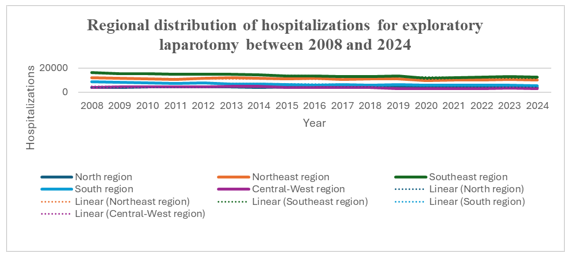
GRAPH 1: Regional distribution of hospitalizations for exploratory laparotomy between 2008 and 2024
Regarding the mortality rate by region for this procedure, Graph 2 shows an increase from 2008 to 2024 in all regions, but with fluctuations in the intermediate periods. The Southeast region presented the highest values, with its peak in 2021 (15.4), the lowest value in 2008 (13.2), and 14.2 in 2024, the most recent year analyzed. The South is the second region with the highest rates, with its peak in 2018 (14.7), the lowest value in 2008 (12.4), and 14.5 in 2024. Only in 2018 and 2024 did the South region present higher
rates than the Southeast, being 14.7 and 14.3 in 2018 and 14.5 and 14.2 in 2024, respectively. The Northeast and Central-West regions present intermediate values, with the first having its peak in 2024 (13.5) and the lowest rate in 2008 (7.7), while the second had its peak in 2023 (12.8) and the lowest rate in 2014 and 2018 (8.9), reaching 11.9 in 2024. The North region presented the lowest values, with the peak in 2024 (7.9) and the lowest value in 2008 (5.5).
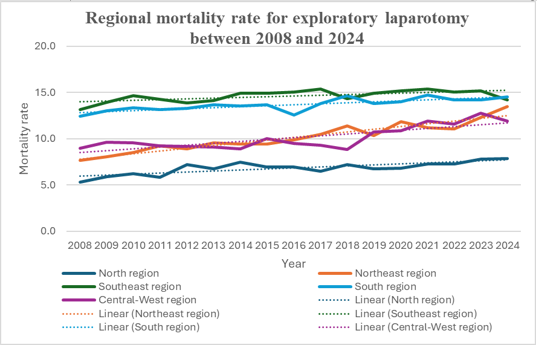
GRAPH 2: Mortality rate for exploratory laparotomy by region between 2008 and 2024.
According to graph 3, the mortality rate varies according to the type of care, being constantly higher in emergency procedures throughout the period analyzed. However, in both types there was an increase from 2008 to 2024, with a slight fluctuation in the intermediate years analyzed.
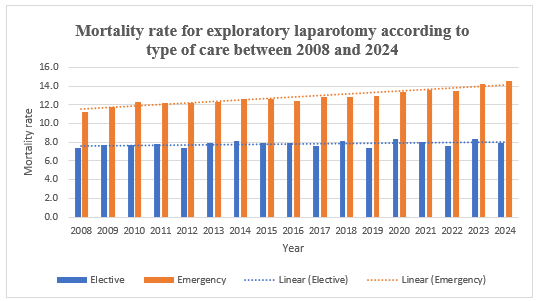
GRAPH 3: Mortality rate by type of care between 2008 and 2024.
Regarding the nature of care, Graph 4 shows that the highest number of hospitalizations and deaths occurs when the procedure is urgent rather than elective. However, regardless of the nature of care, there was a reduction in the number of both from 2008 to 2024, despite fluctuations found in the intermediate period analyzed. The peak of elective hospitalizations was in 2008 (9,280) and that of emergency hospitalizations was also in 2008 (38,411). The highest number of deaths from elective procedures occurred in 2008 (709), while the highest number of deaths from emergency procedures occurred in 2010 (4,654). Based on these data, the average relative risk (RR) of death from emergency exploratory laparotomy calculated for the period analyzed is 1.6, indicating that people who undergo the procedure urgently have, on average, a 1.6 times greater chance of death than those who undergo it electively.
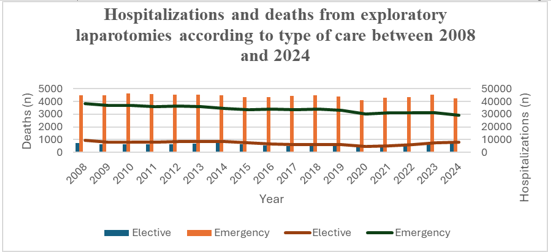
GRAPH 4: Hospitalizations and deaths from exploratory laparotomies by type of care between 2008 and 2024.
Regarding the total amount spent on exploratory laparotomies, according to Graph 5, there was an increase in all regions of Brazil from 2008 to 2024, with some fluctuations in the intermediate years analyzed. In this context, the Southeast region had the highest expenditure, peaking in 2023 ($178,967,996.42) and the lowest in 2008 ($116,778,835.12). The second-highest-spending region was the Northeast, peaking in 2023 ($121,740,677.72) and the lowest in 2008 ($65,758,781.88). The South region is the third-highest-spending region, peaking in 2023 ($91,172,221.88) and the lowest in 2008 ($63,241,382.60). The Central-West and North regions had the lowest expenditures in the period analyzed, with the North having the highest growth among them, ranging from $19,353,546.61 in 2008 to $38,728,694.72 in 2024, therefore with an increase of $19,375,148.11, with its peak in 2023 ($40,746,093.41). The Central-West region, on the other hand, showed an increase of $10,349,530.37, ranging from $26,232,773.48 in 2008 to $36,582,303.85 in 2024, with its peak in 2023 ($44,237,780.20).
Discussion
There is a general downward trend in the number of admissions for exploratory laparotomy in almost all regions of Brazil between 2008 and 2024. The only exception was the North Region, which showed atypical behavior, with an increase in the number of procedures. This disparity may be influenced by unequal access to imaging tests and health services, in addition to different clinical interpretations for surgery indications in each region. This may also be explained by the increase in the number of videolaparoscopic procedures that were not included in this study.
The Southeast Region stood out with the highest number of admissions and the highest costs of procedures throughout the analyzed period, a fact that can be explained by the high population density and the concentration of referral hospitals in the area. However, it also recorded the highest mortality rates, which may be related to the complexity of the cases treated,6 seen in severe and acute clinical conditions, such as penetrating trauma, intestinal perforations, pancreatitis, or abdominal cancer, which require immediate and high-risk surgical intervention.
Regarding mortality, the study reinforces that emergency procedures have a much more negative impact on clinical outcomes, given that the mortality rate was consistently higher in emergency cases than in elective procedures.7,8 The relative risk (RR) of 1.6 calculated for the period indicates that the probability of a patient dying from an emergency laparotomy is, on average, 1.6 times greater than from an elective procedure, a fact that highlights the clinical severity of emergency patients, as well as the limited time for preoperative stabilization.
The study's findings are consistent with the literature, which highlights the complexity of the procedure and the risk of complications. For example, a study of 100 exploratory laparotomy cases performed at Guru Nanak Dev Hospital (India) revealed a 9% mortality rate, primarily associated with perforations and severe clinical conditions. The most common postoperative complications in the study were pain (100%), fever (71%), paralytic ileus (46%), and wound infection (30%). 5 This high incidence of complications and mortality rate reinforce the need for careful management and rigorous postoperative protocols.
One aspect worth noting is the increase in total spending on exploratory laparotomies. Although the number of hospitalizations has decreased, the increase in costs may be related to the greater complexity of cases, which require longer hospital stays, intensive care unit support, and the use of additional resources. 9 This suggests that, although the number of surgeries has decreased, those currently performed are more serious and require more resources.
Because it is based on secondary data, the study does not allow for the analysis of detailed clinical and social factors, such as patient severity, the presence of other diseases, or the quality of postoperative care. Furthermore, the research does not consider possible biases in records or the lack of specific information on the cause of death. Because it focuses solely on public data, the study also does not include procedures performed in private hospitals.
Conclusions
The high mortality rate in emergency procedures, in contrast to elective procedures, points to a worse prognosis for emergency exploratory laparotomy. Continuous improvement of emergency care protocols and increased research on the subject are essential to improve clinical outcomes and maximize the effectiveness of this procedure in critical situations.
References
- A.D.A.M. Medical Encyclopedia. Exploratory laparotomy [Internet]. MedlinePlus; 2025.
View at Publisher | View at Google Scholar - Strohl EL. Exploratory laparotomy. JAMA. 1961;176(12):1038-40.
View at Publisher | View at Google Scholar - Witkowski LJ, Anderson J. The role of exploratory laparotomy in modern surgical practice. Ann Surg. 1960; 152:245-50.
View at Publisher | View at Google Scholar - Pooria A, Pourya A, Gheini A. Outcomes of non-operative management in penetrating abdominal trauma: a retrospective study. Int J Surg. 2020; 73:58-62.
View at Publisher | View at Google Scholar - Kapoor S. Analysis of postoperative complications in exploratory laparotomy: a study of 100 cases. Int Surg J. 2017;4(4):1182-6.
View at Publisher | View at Google Scholar - Farias-Júnior H, Lima J, Costa M, Lira T, Santos J, Andrade R, et al. Perfil epidemiológico de trauma abdominal submetido à laparotomia exploradora. Rev Col Bras Cir. 2019;46(4):20192237.
View at Publisher | View at Google Scholar - Costa C, Almeida R, Silva P, Oliveira L, Rodrigues M. Preditores de mortalidade intra-hospitalar em pacientes submetidos a cirurgias não eletivas em um hospital universitário: um estudo de coorte retrospectivo. Rev Bras Anestesiol. 2018;68(5):492-500.
View at Publisher | View at Google Scholar - Pereira F, Mendes S. Cirurgia laparoscópica vs cirurgia convencional: custos em saúde [dissertation]. Coimbra: Escola Superior de Enfermagem de Coimbra; 2020.
View at Publisher | View at Google Scholar - Souza M, Santos A, Ferreira L, Gomes R. Outcomes and associated factors of open abdomen after urgent laparotomy at a University Hospital in Southern Brazil: a retrospective study. Rev Col Bras Cir. 2022; 49:20223293.
View at Publisher | View at Google Scholar