 Clinic
Research Article | DOI: https://doi.org/10.31579/2834-8761/082
Cross-Cultural Validity and Reliability of the Birth Satisfaction Scale-Revised (BSS-R): A Systematic Review
- Anne Chidinma Nwogu *
- Yarhere Iroro
- Ayisetu U. Musa-Malilki
1Department of Midwifery & Child Health, World Bank Africa Centre of Excellence for Public Health & Toxicological Research, University of Port Harcourt, Port Harcourt, Nigeria.
2College of Health Sciences, University of Port Harcourt, Port Harcourt.
3Department of Nursing Sciences, Ahmadu Bello University, Zaria.
*Corresponding Author: Anne Chidinma Nwogu, Department of Midwifery & Child Health, World Bank Africa Centre of Excellence for Public Health & Toxicological Research, University of Port Harcourt, Port Harcourt, Nigeria.
Citation: Anne Chidinma Nwogu, Yarhere Iroro, Ayisetu U. Musa-Malilki, (2025), Cross-Cultural Validity and Reliability of the Birth Satisfaction Scale-Revised (BSS-R): A Systematic Review, Clinical Endocrinology and Metabolism 4(3): 10.31579/2834-8761/082
Copyright: © 2025, Anne Chidinma Nwogu. This is an open access article distributed under the Creative Commons Attribution License, which permits unrestricted use, distribution, and reproduction in any medium, provided the original work is properly cited.
Received: 16 April 2025 | Accepted: 30 April 2025 | Published: 05 May 2025
Keywords: birth; cross-cultural comparison; postpartum period; satisfaction
Abstract
The Birth Satisfaction Scale-Revised (BSS-R) is used to assess women’s satisfaction with childbirth experiences. With an increase in its popularity, many studies have translated and validated the BSS-R in different languages and cultures. This review examined the validity and reliability of the translated versions of the BSS-R. A search was done across three research databases (PubMed, ScienceDirect, and EBSCO essentials) to identify related studies. In addition, manual searches were conducted on the reference lists of the identified studies. Only studies published within the past twenty-year period (2004-2024), in English language, in peer reviewed journals, and assessed the psychometric properties of translated BSS-R versions were considered. Relevant data were extracted using a form, and analysed descriptively. Eight studies involving 2,730 women from diverse countries (Turkey, Japan, Iran, Saudi Arabia, Nigeria, and Hungary) met the inclusion criteria. confirmatory factor analysis consistently supported the three-factor structure of the BSS-R. Cross-cultural validity was generally high, with values ranging from 0.88-0.99 (Acceptable level > 0.85). A greater proportion of the studies (5 out of 8) reported internal consistency above 0.70 for the total scale, but there were mixed results in the internal consistency of the subscale domains. Stress Experienced (0.41-0.80) and Women’s Attributes (0.41-0.71) inadequate internal consistency than Quality of Care (0.72-0.86).The BSS-R demonstrated satisfactory validity across cultural contexts, supporting its widespread use for measuring birth satisfaction. The less optimal subscale internal consistency indicates a need for further research on BSS-R adaptation and validation.
Introduction
Birth satisfaction is an indicator of maternity care quality (Lazzerini et al., 2020). On one hand, positive satisfaction with birth experience can limit fear of childbirth and promote favourable reproductive health decisions (Eitenmüller et al., 2022). On the other hand, poor satisfaction with birth experience may promote postpartum depression and long term birth-related phobia (Demirel et al., 2022). Assessing birth satisfaction is therefore essential for evaluating the quality of maternity care and identifying areas for improvement (Liu et al., 2021). The Birth Satisfaction Scale-Revised (BSS-R) is a widely used tool for assessing and quantifying women’s satisfaction with childbirth experience (Doherty et al., 2023). The tool was originally developed in the United Kingdom by Martin and Martin (2014) to provide a comprehensive assessment of three domains: Quality of Care, Women’s Attributes, and Stress Experienced during labour and delivery. The 10-item scale has gained popularity for its brevity and ease of use (Emmens et al., 2023). Researchers and clinicians consider the BSS-R valuable as it allows for a quick and thorough assessment of birth satisfaction (Nespoli, et al., 2021). More so, clinicians anticipate that the tool can facilitate comparisons across healthcare systems, populations, and cultures. In light of the cultural diversity in childbirth practices and healthcare systems globally, the BSS-R has undergone translation and validation across multiple languages to ascertain its applicability across various cultures (Ratislavová et al., 2024). The cross-cultural adaptation of tools such as the BSS-R is crucial for preserving both linguistic and conceptual equivalence which ensures that the tool effectively mirrors the experiences and anticipations of women across diverse cultural backgrounds (D’Sa et al., 2024). The process of cross-cultural adaptation generally entails a rigorous sequence of translation, back-translation, psychometric validation, and reliability testing for validity, reliability and internal consistency within different cultural contexts (Fellmeth et al., 2021). Despite the widespread use of BSS-R, there exists a notable lack of systematic reviews concerning its psychometric properties across cultural settings. While numerous studies like Abrán et al. (2024), Anikwe et al. (2022), and Ratislavová et al. (2022) have reported on reliability and validity of BSS-R following translation into various languages; the findings have not been organized and synthesised in previous literature to reflect the true picture of its cross cultural validity and reliability. A review is necessary to determine how well BSS-R performs across different cultures and to identify potential gaps or areas where further validation is required. This systematic review aimed to collate and synthesize findings from previous studies that have translated and validated BSS-R in different languages and cultural contexts. This review seeks to inform and contribute to improving measurement of birth satisfaction in diverse cultures and healthcare settings.
Methods
Study Design and Search Strategy
This review followed the Preferred Reporting Items for Systematic Reviews and Meta-Analyses (PRISMA) guidelines (Sarkis-Onofre et al., 2021). Three databases (PubMed, ScienceDirect, EBSCO essentials) were systematically searched for studies on the validation of the BSS-R. The search terms included: (Validity OR Reliability) AND (Birth Satisfaction Scale-Revised OR BSS-R). The search was limited to peer-reviewed articles published between 2004 and 2024. A manual search on the list of references in the identified studies were also conducted using the ancestor and descendant approach.
Eligibility Criteria
Studies were included if they translated and validated the BSS-R, reported psychometric properties (validity and reliability), had available full-text, and published in English language. Reviews, commentaries, and conference abstracts were excluded.
Data Extraction
The titles and abstracts of retrieved studies were independently assessed by members of the research team. The full text versions of the studies were then examined for eligibility, and data extraction was done using a form. Collected data included: author and year of publication, country, sample size, translation language; content, construct and cross-cultural validity, internal consistency and reliability (Intraclass Correlation Coefficient [ICC], Spearman rho). All discrepancies in the data independently obtained by the research team members were resolved by discussion and consensus.
Quality Assessment
The quality of the studies was appraised using the COSMIN Risk of Bias checklist for methodological quality (Mokkink et al., 2020). Each study was independently rated by the members of the research team as excellent, good, fair, or poor. Dissimilarities in ratings were resolved through discussion until consensus was reached, and only studies rated fair to excellent were included.
Data Synthesis
A descriptive synthesis approach was used to summarize the psychometric properties reported across studies. Ranges of psychometric indices were reported. No meta-analysis performed.
Results
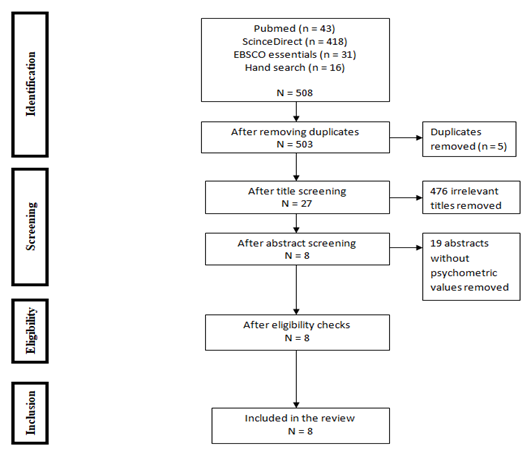
Figure 1: Prisma flow diagram.
The Preferred reporting items for systematic reviews and meta-analyses PRISMA flow diagram in Figure 1 presents the study selection process. The initial search yielded a total of 508 studies. After removing 5 duplicate records, 503 studies remained for title and abstract screening. During this phase, 476 non-related titles and 19 abstracts were excluded due to failure to meet inclusion criteria. A total of 8 full-text articles were assessed for eligibility and included in the review.
Author (Year) | Country of Study | Study Design | Sample Size | Sample Description | Language of Translation | Content Validity | Construct validity | Cross Cultural Validity | Total Scale Internal Consistency | Subscale Internal Consistency | Reliability ICC or Spearmanrho) | |||
Stress Experienced | women ‘Attributes | Quality of Care | ||||||||||||
Göncü Serhatlıoğlu et al. (2018) | Turkey | Survey with Confirmatory Factor Analysis (CFA) | 120 | Healthy childbearing women who experienced spontaneous delivery at term | Turkish | Not specified | Confirmed using CFA for a three-factor structure | 0.94 | 0.71 | 0.55 | 0.44 | 0.74 | Not specified | |
Tezuka et al. (2024) | Japan | Internet-based cross-sectional study with CFA | 445 | Japanese- women within 2 months of childbirth | Japanese | Not specified | Confirmed using CFA for a three-factor structure | Not specified | 0.71 | Not specified | Not specified | Not specified | Not specified | |
Mortazavi et al. (2021) | Iran | Survey with CFA | 784 | Women hospitalized in postpartum wards | Persian | Not specified | Confirmed using CFA for a three-factor structure | Not specified | 0.76 | 0.53 | 0.63 | 0.72 | Not specified | |
Nasiri et al. (2020) | Iran | Methodological cross-sectional study with CFA | 212 | Postpartum women who gave birth in the last year | Persian | Expert feedback Content validity index not specified | Confirmed using CFA for a three-factor structure | 0.98 | 0.74 | 0.80 | 0.70 | 0.76 | 0.77 | |
D'Sa et al. (2024) | Saudi Arabia | Cross-sectional study with CFA | 218 | Saudi women | Arabic | Not specified | Confirmed using CFA for a three-factor structure | 0.88 | 0.40 | 0.41 | 0.41 | 0.86 | Not specified | |
Anikwe et al. (2022) | Nigeria | Crosssectional study with reliability and validation analyses | 500 | Postpartum women at a University Teaching Hospital | Igbo | Not specified | Not specified | Not specified | 0.62 | Not specified | Not specified | Not specified | 0.65 | |
Gökmen et al. (2022) | Turkey | Methodological study with EFA and CFA | 219 | Women in the maternity ward of a State Hospital | Turkish | Assessed through specialist feedback | Confirmed using CFA for a three-factor structure | 0.90 | 0.72 | 0.70 | 0.71 | 0.78 | Not specified | |
Abrán et al. (2024) | Hungary | Validation study | 232 | Postpartum women in a hospital maternity unit | Hungarian | Not specified | Confirmed using CFA for a three-factor structure | 0.99 | Not specified | Not specified | Not specified | Not specified | Not specified | |
CFA = Confirmatory Factor Analysis; EFA = explanatory factor analysis; cross cultural validity > 0.85 = acceptable; internal consistency > 0.70 = acceptable, reliability > 0.70 acceptable
Table 1: Description of the included studies
Table 1 shows the characteristics of all eight studies included in this review, which was conducted in six countries: Turkey, Japan, Iran, Saudi Arabia, Nigeria, and Hungary. These studies involved a total of 2,730 postpartum women, recruited in hospitals or health centres. The BSS-R was translated into Arabic, Hungarian, Igbo, Japanese, Persian (in two studies), and Turkish (in two studies). Content validity was assessed in two studies (Nasiri et al., 2020; Gökmen et al., 2022) but the content validity index was not specifically reported. Cross-cultural validity was extensively evaluated, with most studies confirming acceptable results with Confirmatory Factor Analysis (CFA) index ranging from 0.88 to 0.98. The internal consistency was acceptable across the studies with Cronbach’s alpha for the entire scale ranging from 0.62 to 0.76 with most reporting above the 0.70 criterion. Nonetheless, the subscale internal consistency was suboptimal for “Stress Experienced" (range: 0.40-0.80), "Women’s Attributes" (0.41-0.71), and "Quality of Care" (0.41 and 0.86). Reliability, as measured using the intraclass correlation coefficient (ICC) or Spearman’s rho, was reported in two studies and showed mixed results. Nasiri et al. (2020) found an ICC reliability value of 0.77, which is considered acceptable, whereas Anikwe et al. (2022) reported a Spearman’s rho value of 0.65, which is slightly below the acceptable threshold of 0.70.
Discussion
This review found that the BSS-R has good cross-cultural validity. This indicates that the scale measures the intended constructs consistently across different cultural settings. This finding corroborates Radoš et al. (2022) and Ratislavová et al. (2022) who reported that the scale has adequate and acceptable psychometric results and can be used in multicultural settings. This review noted that the BSS-R had suboptimal scale and subscale internal consistency. This finding highlights potential differences in how aspects of birth satisfaction are perceived or experienced across cultures, suggesting the need for further refinement. This finding supports D'Sa et
al.’s (2024) call for further adaptation and fine tuning efforts on the BSS-R. The call for further adaptation studies also aligned with Mortazavi et al. (2021). This review revealed mixed results concerning the reliability of the BSS-R assessed through intraclass correlation coefficient (ICC) or Spearman’s rho. This finding indicates variability in how reliably the BSS-R measures birth satisfaction over time in different cultural settings. This finding contrasted Nasiri et al. (2020) who wrote that the scale has adequate stability. This finding indicates that future studies need to focus on testing the short and long term test-retest reliability of the BSS-R.
Limitations
The review only included studies published in English, potentially excluding valuable research conducted in non-English-speaking regions.
This may have affected the assessment of cross-cultural validity from studies in non-English speaking countries. Additionally, this systematic review started as an academic exercise, therefore was not registered in PROSPERO.
Conclusion
BSS-R demonstrated a strong cross-cultural validity and less optimal scale and subscale internal consistency. The results of this study indicate a need for further validation studies. Careful consideration of subscale reliability and ongoing validation efforts are recommended to ensure applicability across cultures and clinical settings.
Acknowledgement
The authors are grateful to the librarian and all staff of the World Bank Africa Centre of Excellence for Public Health & Toxicological Research, University of Port Harcourt for their cooperation and critique.
References
- Abrán, H., Kovács, K., Horvát, Z., Erőss, E., Martin, C.et.al. (2024). Translation and validation of the Hungarian version of the Birth Satisfaction Scale-Revised (BSS-R). Midwifery, 132(1), 103983.
View at Publisher | View at Google Scholar - Anikwe, C., Osita, U. S., Mbanefo, P. O., Asiegbu, O. G., Nnadozie, U. et.al. (2022). The Birth Satisfaction Scale: Igbo adaptation, validation, and reliability study. Qeios, (1), 1-16. https://doi.org/10.32388/GOVO55.
View at Publisher | View at Google Scholar - Demirel, G., Kaya, N., & Evcili, F. (2022). The relationship between women’s perception of support and control during childbirth on fear of birth and mother’s satisfaction. Journal of Obstetrics and Gynaecology, 42(1), 83-90.
View at Publisher | View at Google Scholar - Doherty, J., Coughlan, B., Lynch, S., Sheehy, L., Martin, C. et.al. (2023). The importance of communication and involvement in decision-making: A study in Ireland exploring birth satisfaction using the Birth Satisfaction Scale-Revised (BSS-R). European Journal of Midwifery, 7(1), e1.
View at Publisher | View at Google Scholar - D'Sa, J. L., Jahlan, I. O., Alsatari, E. S., Zamzam, S., & Martin, C. R. (2024). Psychometric properties of a Saudi Arabian version of the Birth Satisfaction Scale-Revised (BSS-R). Belitung Nursing Journal, 10(1), 105-113. https://doi.org/10.33546/bnj.3055.
View at Publisher | View at Google Scholar - Eitenmüller, P., Köhler, S., Hirsch, O., & Christiansen, H. (2022). The impact of prepartum depression and birth experience on postpartum mother-infant bonding: A longitudinal path analysis. Frontiers in Psychiatry, 13(1), e815822.
View at Publisher | View at Google Scholar - Emmens, B., Hollins Martin, C. J., & Martin, C. R. (2023). Translation and validation of the Dutch version of the Birth Satisfaction Scale-Revised (BSS-R). Journal of Reproductive and Infant Psychology, 41(2), 213-227.
View at Publisher | View at Google Scholar - Fellmeth, G., Harrison, S., Opondo, C., Nair, M., Kurinczuk, J. et.al. (2021). Validated screening tools to identify common mental disorders in perinatal and postpartum women in India: a systematic review and meta-analysis. BMC psychiatry, 21(1), 1-10.
View at Publisher | View at Google Scholar - Göncü Serhatlıoğlu, S., Karahan, N., Hollins Martin, C. J., & Martin, C. R. (2018). Construct and content validity of the Turkish Birth Satisfaction Scale - Revised (T-BSS-R). Journal of Reproductive and Infant Psychology, 36(3), 235-245. https://doi.org/10.1080/02646838.2018.1443322.
View at Publisher | View at Google Scholar - Gökmen, Ö. Ö., Erbil, N., & Demirbağ, B. (2022). Adaptation of Birth Satisfaction Scale-Revised to Turkish society. Middle Black Sea Journal of Health Science, 8(4), 490-505. https://doi.org/10.19127/mbsjohs.1080337.
View at Publisher | View at Google Scholar - Lazzerini, M., Mariani, I., Semenzato, C., & Valente, E. P. (2020). Association between maternal satisfaction and other indicators of quality of care at childbirth: a cross-sectional study based on the WHO standards. BMJ open, 10(9), e037063.
View at Publisher | View at Google Scholar - Liu, Y., Li, T., Guo, N., Jiang, H., Li, Y., Xu, C., & Yao, X. (2021). Women’s experience and satisfaction with midwife-led maternity care: a cross-sectional survey in China. BMC pregnancy and childbirth, 21(1), 1-10.
View at Publisher | View at Google Scholar - Martin, C. J. H., & Martin, C. R. et.al. (2014). Development and psychometric properties of the Birth Satisfaction Scale-Revised (BSS-R). Midwifery, 30(6), 610-619.
View at Publisher | View at Google Scholar - Mokkink, L. B., Boers, M., Van Der Vleuten, C. P. M., Bouter, L. M., Alonso, J. (2020). COSMIN Risk of Bias tool to assess the quality of studies on reliability or measurement error of outcome measurement instruments: a Delphi study. BMC Medical Research Methodology, 20(1), 1-13.
View at Publisher | View at Google Scholar - Mortazavi, F., Mehrabadi, M., Hollins Martin, C. J., & Martin, C. R. (2021). Psychometric properties of the Birth Satisfaction Scale-Revised (BSS-R) in a sample of postpartum Iranian women. Health Care for Women International, 42(4-6), 836-851. https://doi.org/10.1080/07399332.2020.1802464
View at Publisher | View at Google Scholar - Nasiri, S., Kariman, N., & Ozgoli, G. (2020). Psychometric properties of the Iranian version of the Birth Satisfaction Scale-Revised. Journal of Research in Medical Sciences, 25(1), 90. https://doi.org/10.4103/jrms.JRMS_248_19.
View at Publisher | View at Google Scholar - Nespoli, A., Colciago, E., Fumagalli, S., Locatelli, A., Hollins Martin. (2021). Validation and factor structure of the Italian version of the Birth Satisfaction Scale-Revised (BSS-R). Journal of Reproductive and Infant Psychology, 39(5), 516-531.
View at Publisher | View at Google Scholar - Radoš, N. S., Matijaš, M., Brekalo, M., Hollins Martin, C. J. (2022). Further validation of the Birth Satisfaction Scale-Revised: Factor structure, validity, and reliability. Current Psychology, 42(1), 13693–13702. https://doi.org/10.1007/s12144-021-02688-2
View at Publisher | View at Google Scholar - Ratislavová, K., Hendrych Lorenzová, E., Hollins Martin, C. J., & Martin, C. R. (2022). Translation and validation of the Czech Republic version of the Birth Satisfaction Scale-Revised (BSS-R). Journal of Reproductive and Infant Psychology, 2022(1), 1–17. https://doi.org/10.1080/02646838.2022.2067837.
View at Publisher | View at Google Scholar - Ratislavová, K., Horová, J., & Marek, P. (2024). Measuring Women’s Satisfaction with Childbirth: A Literature Review of Measurement Properties. Slovenian Journal of Public Health, 63(2), 100-108.
View at Publisher | View at Google Scholar - Sarkis-Onofre, R., Catalá-López, F., Aromataris, E., & Lockwood, C. (2021). How to properly use the PRISMA Statement. Systematic Reviews, 10(1), 1-3.
View at Publisher | View at Google Scholar - Tezuka, A., Hiroyama, N., Suzuki, M., Matsuoka, M., Martin, C. J. H., & Martin, C. R. (2024). Translation and validation of the Japanese version of the Birth Satisfaction Scale-Revised. Japanese Journal of Nursing Science, 21(1), e12569. https://doi.org/10.1111/jjns.12569.
View at Publisher | View at Google Scholar